Hyundai Commits to 30,000 US-Built Robots a Year by 2028
Hyundai will start US robot production in 2028 at 30,000 units annually, and its Georgia robot testing center is expanding tenfold this year with 25,000 orders already booked.
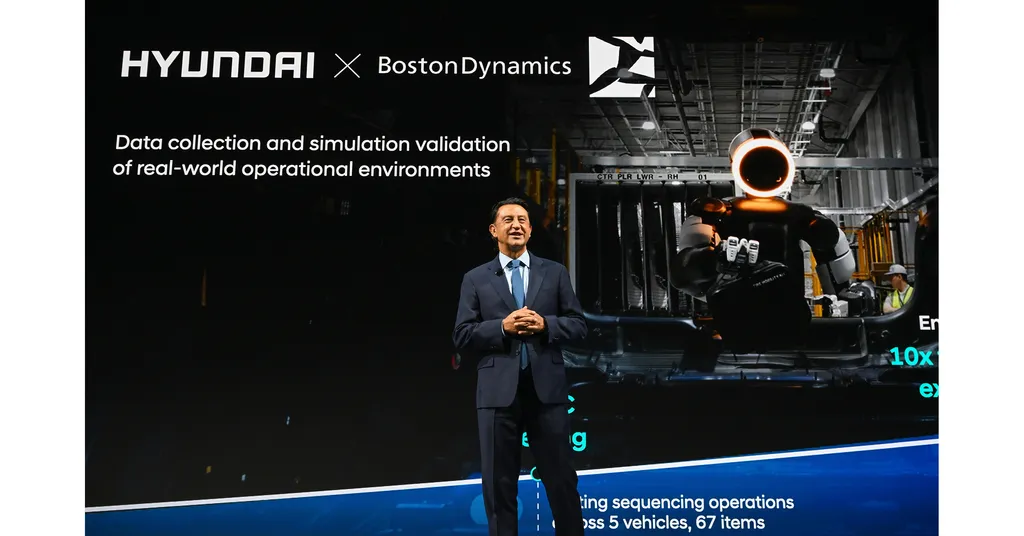
Hyundai Motor Company told investors on August 26 that it will begin building robots in the United States in 2028 at a rate of 30,000 units a year, and that the Georgia facility where it currently tests manufacturing robots on real factory conditions will expand more than tenfold by the end of this year. The company also disclosed a separate, not-yet-sited US robot manufacturing plant that already has 25,000 units of guaranteed customer orders before a location has been finalized. Together, the announcements describe a company reorganizing a meaningful share of its US industrial footprint around building and deploying robots, not just cars, with the humanoid-robot subsidiary Boston Dynamics as the technology anchor.
The capacity commitments
At Hyundai’s 2026 CEO Investor Day, held August 26-27, the company’s own press release states plainly: “U.S. robot production begins in 2028 with 30,000 units of annual capacity.” That figure sat inside a broad, multi-segment investor presentation covering EVs, the Genesis luxury brand, autonomous driving and its Waymo partnership, and battery manufacturing, so the robotics commitment is one piece of a larger capital-allocation story, not a standalone product launch.
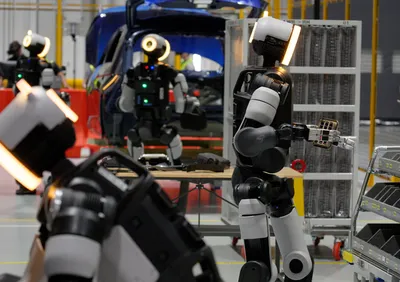
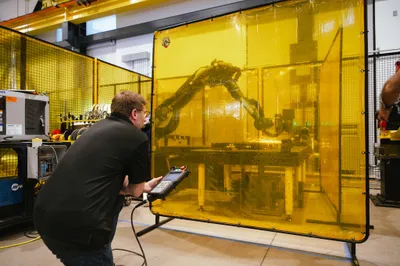
The more immediate news came from Hyundai president and CEO Jose Antonio Munoz, speaking at the same event and reported first by Manufacturing Dive: Hyundai’s Robot Metaplant Application Center, which opened in June 2026, will expand more than tenfold by the end of 2026. RMAC sits inside Hyundai Motor Group Metaplant America in Savannah, Georgia, the same complex where Hyundai builds its electric vehicles, and its job is to simulate real factory conditions, train manufacturing robots on them, collect operational data, and run testing and verification before a robot goes into commercial production. That is the pipeline Hyundai is scaling up nearly a year and a half before the 2028 production start date it named for its own robots.
Separately, Munoz said Hyundai is investing in a new US robotics manufacturing facility, distinct from the Metaplant America robot-production line, whose location has not yet been finalized. He said the first 25,000 units of that facility’s output are already guaranteed by customer orders, a demand signal ahead of a site decision that is unusual even by the standards of a company otherwise disclosing forward-looking capacity targets rather than firm commitments.
Munoz framed the shift in blunt terms: “We are transitioning to a physical AI and technology company… We will be building, deploying, even financing robotics at scale.” On the capacity buildout specifically, he said: “We cannot do that without more capacity.”
Where Boston Dynamics fits
Boston Dynamics became a wholly-owned Hyundai subsidiary in July 2026, when Hyundai acquired SoftBank’s remaining shares for roughly $325 million, as first reported by the South Korean outlet Maeil Business. That completed a process that began in 2021, when Hyundai bought a controlling 80% stake from SoftBank for $1.1 billion.
Hyundai and Boston Dynamics have already been integrating humanoid and quadruped robots into Hyundai’s existing factories: Atlas and the Spot quadruped are in ongoing use for industrial inspection work across Hyundai plants today, independent of the milestones below. What is new is a specific deployment timeline at Metaplant America: Hyundai plans to put Atlas to work there in 2028 doing parts-sequencing tasks, the same year US robot production capacity comes online, expanding to component assembly by 2030. Boston Dynamics’ product line also includes Stretch, a mobile robot built for warehouse case handling, though Stretch was not part of the Metaplant America timeline Munoz described.
Why the framing matters
This is not a capital-markets story about a robotics IPO or funding round; it is a manufacturing-capacity story about a car company building physical infrastructure to produce and deploy robots domestically, mirroring how this desk covered LG and NVIDIA’s CLOiD factory pilot by leading with the concrete factory-pilot detail over the humanoid reveal itself. The RMAC tenfold expansion and the 25,000-unit guaranteed order book are the parts of this announcement with the shortest timelines and the most specific numbers; the 2028 Atlas parts-sequencing deployment and 2030 assembly expansion are real but further out, and contingent on RMAC’s testing and validation work succeeding on schedule.
Automotive still supplies nearly 80% of Hyundai’s revenue, and it is that business funding the robotics and autonomous-vehicle buildout. Hyundai has separately committed to building over 80% of the vehicles it sells domestically in the US by 2030, and Munoz said the same domestic-production target now applies to robots as well, tying the robotics ramp to the same reshoring logic already driving Hyundai’s automotive manufacturing decisions.
Sources
- Hyundai Motor Company Charts Profit-Driven Growth Roadmap at 2026 CEO Investor Day — PR Newswire / Hyundai Motor Company, Aug 26, 2026
- Hyundai seeks to diversify revenue with its latest robotics acquisition — Manufacturing Dive, Aug 28, 2026
Frequently asked questions
What exactly did Hyundai commit to at its 2026 investor day? +
Hyundai said US robot production begins in 2028 with 30,000 units of annual capacity, per its own investor-day press release. Separately, CEO Jose Munoz said Hyundai's Robot Metaplant Application Center in Savannah, Georgia will expand more than tenfold by the end of 2026, and that a new, not-yet-sited US robot manufacturing facility already has 25,000 units of guaranteed customer orders.
What is the Robot Metaplant Application Center, and where is it? +
RMAC is a facility inside Hyundai Motor Group Metaplant America in Savannah, Georgia, the same complex where Hyundai builds its electric vehicles. It opened in June 2026 and is used to simulate real factory conditions, train manufacturing robots, collect operational data, and run testing and verification ahead of commercial production.
When will Boston Dynamics' Atlas humanoid actually work at a Hyundai plant? +
Hyundai plans to deploy Atlas at Metaplant America in 2028 for parts-sequencing tasks, expanding to component assembly by 2030. That is distinct from ongoing use of Atlas and the Spot quadruped for industrial inspection across Hyundai factories today, which is not tied to the 2028/2030 milestones.
Does Hyundai fully own Boston Dynamics now? +
Yes. Hyundai acquired SoftBank's remaining shares in Boston Dynamics in July 2026, for roughly $325 million according to South Korean outlet Maeil Business, making it a wholly-owned subsidiary. Hyundai originally bought a controlling 80% stake from SoftBank in 2021 for $1.1 billion.
More news