AMR Payload Hits 2,000 kg: Only One Fixed Arm Beats It
Pudu's MP2000 claims a 2,000 kg AMR payload. Cross-checked against 400 robots, that would rank #2 overall, ahead of every dedicated palletizer we track.
Pudu Robotics says its new MP2000 autonomous forklift carries 2,000 kg. Cross-check that number against our own 400-robot database and the result is not a new AMR record, it is a new database-wide ranking. A 2,000 kg wheeled robot would land at #2 overall, ahead of every palletizer, every KUKA, and every FANUC we track except one. Only one robot in the entire catalog would still beat it.
What is the Pudu MP2000, and what does Pudu claim it can do?
Pudu Robotics launched the MP2000 on August 18, 2026, as an AI-native autonomous pallet-handling robot, the AMR/AGV class our database tracks separately from fixed articulated arms. Engineering.com’s coverage and The Robot Report’s writeup both corroborate the core spec claims: a 2,000 kg rated payload, 3D lidar plus depth cameras for real-time pallet-location sensing, and a fork-in cycle as fast as 20 seconds. Pudu also states the MP2000 handles three-runner pallets, perimeter-base pallets, and custom or non-standard carriers, which matters more than it sounds. A robot that only forks one pallet geometry is a warehouse fixture. One that forks three is a fleet asset.
None of the three sources publishes a weight, a footprint, or a price for the MP2000, so none of those figures appear here. What we can verify is the payload claim against a dataset we already trust: our own spec database of 400 industrial and mobile robots.
How does 2,000 kg compare to every AMR we already track?
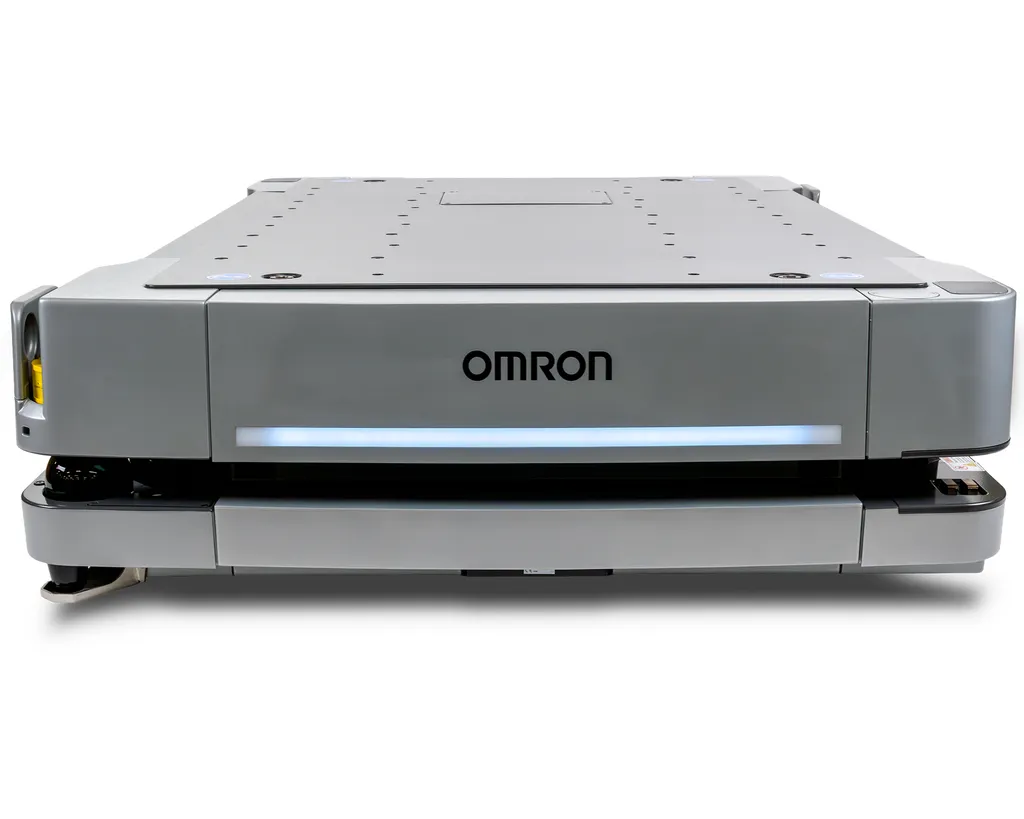
Our database currently classifies exactly 7 robots as AMR type, and every single one of them is Omron. No other brand among our 20 tracked manufacturers has an AMR entry yet.
| Rank | Robot | Payload |
|---|---|---|
| 1 | Omron HD-1500 | 1,500 kg |
| 2 | Omron MD-900 | 900 kg |
| 3 | Omron MD-650 | 650 kg |
| 4 | Omron OL-450s | 450 kg |
| 5 | Omron LD-250 | 250 kg |
| 6 | Omron LD-90 | 90 kg |
| 7 | Omron LD-60 | 60 kg |
| - | Pudu MP2000 (claimed) | 2,000 kg |
Source: our analysis of all 7 AMR-classified robots in the Industrial Robotics Hub database, cross-referenced against Pudu’s own MP2000 launch materials. The MP2000 row is Pudu’s stated claim, not yet an independently verified database entry, since Pudu is not currently one of our 20 tracked brands.
The Omron HD-1500 has held the top AMR payload spot in our catalog since we started tracking the type. Pudu’s claimed 2,000 kg is 33.3 percent above it (2,000 / 1,500 = 1.333). That alone would be a clean, tidy story: new AMR beats old AMR by a third. It is not the interesting part.
Where would 2,000 kg rank against every robot in the database, not just other AMRs?
Here is the whole-catalog picture. Of 400 robots, 399 publish a payload figure. Sorted by payload, regardless of type, this is the top 10.
| Rank | Robot | Type | Payload |
|---|---|---|---|
| 1 | FANUC M-2000iA/1700L | Articulated | 1,700 kg |
| 2 | Omron HD-1500 | AMR | 1,500 kg |
| 3 | FANUC M-1000iA | Articulated | 1,000 kg |
| 3 | KUKA KR 1000 TITAN | Articulated | 1,000 kg |
| 5 | Omron MD-900 | AMR | 900 kg |
| 6 | Estun ER700-2800 | Articulated | 700 kg |
| 6 | FANUC M-410iB/700 | Palletizer | 700 kg |
| 8 | Omron MD-650 | AMR | 650 kg |
| 9 | ABB IRB 7720 | Articulated | 620 kg |
| 10 | Estun ER600-2800 | Articulated | 600 kg |
Source: our analysis of 399 payload-publishing robots (of 400 total) in the Industrial Robotics Hub database, spanning all tracked robot types.
Slot a hypothetical 2,000 kg MP2000 into that table and it does not enter the list, it redraws it. It takes rank #2, pushing every other robot in the table down one place except the FANUC M-2000iA/1700L at the top. That means a claimed 2,000 kg wheeled robot would outrank the KUKA KR 1000 TITAN, a machine whose model name literally invokes titanic scale, at 1,000 kg. It would outrank every dedicated palletizer we track, the FANUC M-410iB/700 tops that category at 700 kg. It would outrank the ABB IRB 7720, one of the heaviest fixed arms in our ABB lineup. Of the 399 robots in our database that publish a payload figure, only one, the FANUC M-2000iA/1700L, would still carry more.
That is the real story here. Not “AMR payload keeps climbing,” which is expected and unremarkable. It is that the gap between the heaviest wheeled AMR and the heaviest bolted-down arm, once a wide and obvious category boundary, has narrowed to a single robot.
Why doesn’t “payload” mean the same thing for a wheeled robot and a fixed arm?
Before anyone reads this as “AMRs are catching fixed arms in strength,” it is worth being precise about what each number measures. We covered this exact distinction in our payload-to-weight ratio analysis across all robot types: AMRs were deliberately excluded from that ratio calculation because the underlying physics is not comparable to a fixed arm’s.
The Omron HD-1500 itself weighs 506 kg while rated to carry 1,500 kg, a payload nearly three times its own mass. That ratio would look absurd next to a FANUC or KUKA arm, and it should, because it is measuring a different kind of work. A fixed articulated arm holds its payload out against gravity through a torque arm, and every kilogram of rated payload has to be resisted by motor torque at the base joint. A wheeled AMR carries its payload as a rolling deck load, distributed across drive wheels and supported directly by the floor. It is closer to a forklift than to a robotic shoulder. Both machines use the word “payload,” and both numbers are real, but they are not measuring the same physical constraint, which is exactly why an AMR’s payload figure can climb past a fixed arm’s without the AMR needing anywhere near the fixed arm’s motor torque or structural mass.
That distinction does not make the MP2000’s claim less real if it holds up. It means the right comparison is not “which machine is stronger,” it is “how much of the fixed-arm payload envelope can now be covered by a robot that also drives itself across a warehouse floor and needs no floor-bolted foundation.” On that question, a verified 2,000 kg AMR would be a genuinely new data point, not a repeat of ground already covered in our payload-to-weight piece or in our payload-vs-reach frontier analysis, which looks at the same economics from the fixed-arm side.
Is 2,000 kg a verified record, or a claim to watch?
Here is the honest caution this piece needs. The 2,000 kg figure is Pudu’s own vendor-published spec claim. It is not, today, an entry in our database, because Pudu is not one of our 20 tracked brands. We have not independently measured a fork-in cycle time, verified the 3D lidar and depth-camera sensing suite against a real deployment, or confirmed the pallet-compatibility claims beyond what Pudu itself states. The same discipline we applied to ABB’s 5.8 m/s PoWa cobot speed claim applies here: we are treating this as a stated claim checked against our own already-verified data, not as an independently confirmed record.
What makes the MP2000 worth writing about before it clears that bar is that the claim, if it holds, does not just extend the AMR category, it collapses most of the remaining distance to the top of our entire payload ranking. A structural boundary that used to be obvious, wheeled robots move things, bolted-down arms lift things, is increasingly a matter of degree rather than kind.
Until Pudu becomes a tracked brand with a verified database record, or another AMR maker publishes a competing figure we can check the same way, treat 2,000 kg as a number to watch rather than a spec to plan a facility around. If it holds, the AMR category will have gone from “add a fifth machine to move pallets” to “the second-strongest robot we track happens to also drive itself.” That is worth revisiting the moment there is a real spec sheet behind it instead of a launch announcement.
Compare these robots