FCC Restricts, HII Invests: Policy Reshapes Robot Supply Chains
FCC restricts foreign mobile robots while HII commits $900M to domestic shipbuilding, as this week's AI claims span wildly different evidence tiers.
The week’s real theme isn’t any single deal — government policy moved robotics supply chains from two opposite directions at once, while the sector’s AI claims landed at wildly different levels of proof. The FCC restricted imports of new foreign mobile robots on national-security grounds; four days later HII committed up to $900 million to two US robotics startups to replace outsourced shipbuilding labor. One mechanism blocks, the other pays — both toward domestic robotics suppliers.
Thread 1: policy pincer, two mechanisms, one direction
The FCC’s Covered List update, effective July 28, turned out broader than initial coverage suggested. Follow-up reporting from MIT Technology Review (Aug. 3) and The Robot Report confirmed the restriction reaches beyond quadrupeds and humanoids to cover essentially all new foreign-built mobile robot categories — AMRs, warehouse platforms, autonomous forklifts, delivery robots — barring them from new FCC equipment-authorization applications. Two carve-outs matter: robots already authorized and in use are untouched, and so are fixed-arm, SCARA, delta, or gantry robots, so the FCC’s mobile-robot restriction leaves the ABB-, KUKA-, Yaskawa- and FANUC-style industrial arm fleet this desk covers daily alone. China has formally opposed the measure — an acknowledged trade friction point now, not a quiet regulatory footnote.
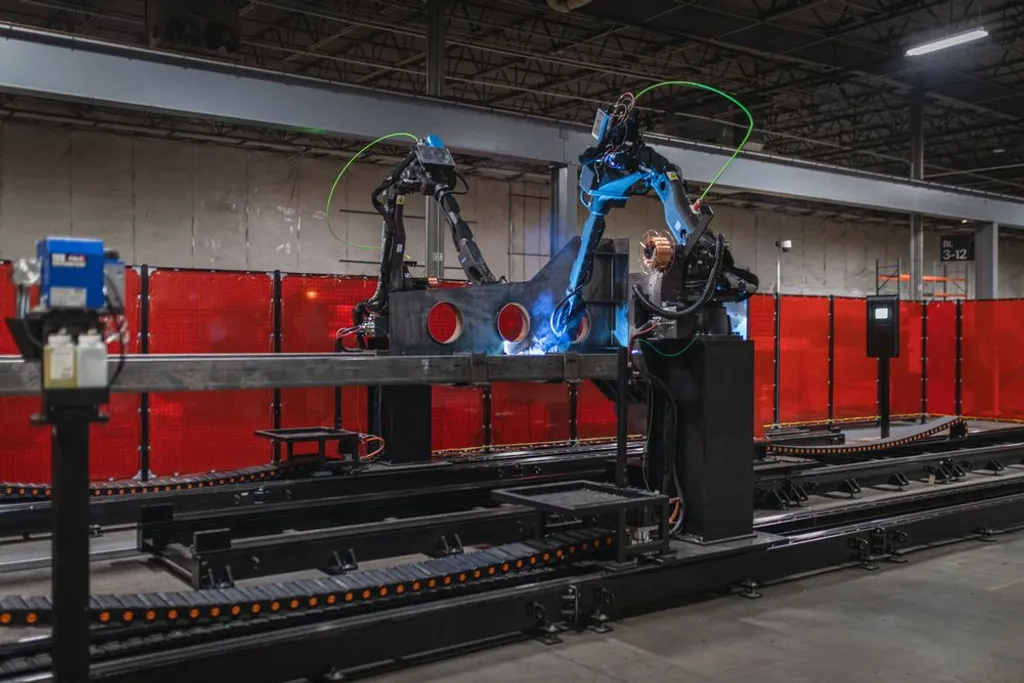
The same week, from the demand side, HII signed performance-based production agreements with Path Robotics (welding) and GrayMatter Robotics (surface prep) worth up to $900 million combined over seven years under its HYPR program. The structure matters as much as the number: HII’s own release frames the figure as contingent on the vendors “meeting clearly defined technology and manufacturing readiness, and performance milestones,” not a signed check. HII says the agreements support outsourcing more than 2.5 million hours of shipbuilding work in 2026, up 30% from 2025. Read together: the FCC restricts where new mobile-robot hardware can come from, and HII sends capital toward two domestic vendors solving a labor-substitution problem the Navy’s shipbuilding schedule can’t otherwise meet — regulation and procurement, favoring the same domestic suppliers in the same seven-day window.
Thread 2: this week’s “physical AI” claims, at three different evidence tiers
Three stories this week claimed physical-AI results, at three distinct levels of verification — worth reading side by side rather than taking any single one at face value.
At the top tier of ambition and the thinnest tier of proof: mimic robotics’ FLUX-mimic, a Video-Action Model built on Black Forest Labs’ video-generation backbone, is now running soft-body assembly tasks at Audi’s Production Lab. The Swiss ETH Zurich spinoff reports a 95% success rate against 55% and 70% baselines, and task-adaptation in roughly 30 minutes versus 30-plus hours for comparable approaches. Both figures are self-reported, and the deployment runs only on mimic’s own robot-and-gripper platform — no independent lab has replicated the benchmark, and it isn’t established whether the model generalizes to a third party’s arm.
In the middle: Avnet and Weston Robot’s edge-AI inspection platform, a 50-TOPS AMD-powered “backpack” mounted on a Unitree quadruped, is a capability announcement with zero disclosed customer deployment, unit count, or performance data. It’s a real product from established companies, but there’s nothing yet to verify or dispute, because no results have been published.
And embedded inside the very real HII contract sits the most consequential unverified claim of the week: GrayMatter Robotics markets its surface-prep systems, under the term “Factory SuperIntelligence,” with claims of “12x throughput of skilled manual labor” and a “95% reduction in rework.” Those numbers appear nowhere in HII’s own release or in independent verification — a vendor’s marketing claim riding inside a real, milestone-gated government contract. A real deployment (mimic), a real partnership with no results (Avnet/Weston), a real contract with unverified vendor math attached (GrayMatter): three different things, one of each this week.
Thread 3: KUKA is building two software layers, not just shipping arms
KUKA’s Automation Management Platform went live in production this week at KUKA Toledo Production Operations — a 335,000-square-foot plant running 285 robots and more than 60,000 connected devices to build 300-plus Jeep Wrangler and Gladiator bodies a day. AMP is described as an “open, modular API platform,” and its initial focus is AMR fleet orchestration rather than the fixed-arm welding lines KTPO is best known for. No throughput, uptime, or cycle-time metrics have been disclosed yet — a capability rollout, not a results story.
The timing is notable: AMP’s go-live follows directly on KUKA’s July 26 announcement that iiQKA.OS2, its individual robot-controller operating system, became the first robot OS certified to IEC 62443-4-2 Security Level 2. Two distinct software layers, shipped by the same company inside two weeks — iiQKA.OS2 secures the controller on a single robot, AMP orchestrates the fleet across an entire plant. That reads less like coincidence and more like a coordinated software push sitting alongside, not replacing, KUKA’s hardware business.
Thread 4: three earnings reports, three profitability trajectories
Q2 2026 results from ABB, Yaskawa, and Doosan Robotics show growth and profitability decoupling in three different ways — stated in prose rather than a chart, since the figures span three currencies (USD, JPY, KRW) and non-aligned fiscal periods that would need heavy normalization to compare directly.
ABB posted record Q2 2026 orders of $12.04 billion, up 30% year-over-year (28% comparable), on revenue of $9.475 billion, up 14% (12% comparable), with a 20.2% operational EBITA margin, up 90 basis points — growth riding data-center-adjacent electrification demand, with the $5.5 billion Rotork deal’s Scheme Document published August 6 ahead of a September 3 shareholder vote, tracking toward an H1 2027 close funded by existing cash plus committed bank facilities. Yaskawa’s overall Q1 FY2026 revenue rose 10.6%, but Robotics segment operating profit collapsed 82.3% to ¥888 million on ERP-migration and Europe-restructuring costs — a company growing overall while its core robotics unit absorbs one-time pain. Doosan Robotics is the new data point this week, completing rather than repeating last week’s picture: Q2 2026 revenue jumped 290% year-over-year to ₩17.7 billion on the ONExia acquisition and 127% US-subsidiary growth, North America now 53% of first-half 2026 revenue — but operating and net losses only narrowed, not turned positive. Three companies, three trajectories, one quarter: ABB compounding on electrification tailwinds, Yaskawa absorbing a self-inflicted wound inside otherwise healthy growth, Doosan scaling revenue faster than it’s closing the gap to breakeven.
What connects the threads
Every thread traces back to the same force: robotics is being pulled into a policy-and-capital story bigger than any single product launch. Regulation and procurement both favored domestic suppliers this week; the physical-AI claims spanned unreplicated benchmarks, bare announcements, and marketing math riding inside a real contract; KUKA bet on software as the next edge; and earnings showed capital rewarding different things at different companies in the same quarter.
Sources
- Trump's AI protectionism has come for robotics — MIT Technology Review, Aug 3, 2026
- Industry reacts to FCC ban on U.S. imports of new humanoid, quadruped robots — The Robot Report, Aug 3, 2026
- FCC's Public Safety and Homeland Security Bureau Announces Addition of Foreign-Produced Power Inverters and Advanced Robotic Devices to FCC Covered List (DA 26-786) — Federal Communications Commission, Jul 28, 2026
- HII Signs Performance-based Production Agreements with Path Robotics and GrayMatter Robotics — HII Newsroom, Aug 6, 2026
- Introducing FLUX-mimic: Scaling Video-Action Models for General Purpose Dexterity — mimic robotics, Jul 23, 2026
- Avnet and Weston Robot partner to launch edge AI inspection platform — The Robot Report, Aug 5, 2026
- KUKA AMP begins operations at KUKA Toledo Production Operations — KUKA AG, Jul 20, 2026
- Q2 2026 results — Record-high orders, strong operational execution and value creation through M&A — ABB, Jul 16, 2026
- Consolidated Results for the First Quarter of Fiscal Year Ending February 28, 2027 [IFRS] — YASKAWA Electric Corporation, Jul 10, 2026
- Doosan Robotics Narrows Q2 Operating Loss to 14.4 Billion Won — Seoul Economic Daily, Jul 24, 2026
Frequently asked questions
Did the FCC actually ban all foreign robots? +
No. The FCC Covered List blocks new foreign-built mobile robots — AMRs, quadrupeds, humanoids, warehouse platforms, delivery robots — from FCC equipment authorization going forward. It does not affect already-authorized models already in use, and it does not touch fixed-arm, SCARA, delta, or gantry robots.
How much will HII actually pay Path Robotics and GrayMatter Robotics? +
Up to $900 million combined over seven years, but the deal is milestone-gated, not a guaranteed lump sum — payment depends on the vendors clearing staged technology and performance milestones across Navy shipbuilding programs.
What's driving the gap between ABB's record earnings and Yaskawa's robotics profit collapse? +
ABB's order growth (+30% year-over-year, +28% comparable) is riding data-center-adjacent electrification demand. Yaskawa's Robotics segment profit fell 82.3% on one-time ERP-migration and Europe-restructuring costs, even as the company's overall revenue grew 10.6%.
Why does KUKA's AMP launch matter given last week's iiQKA.OS2 certification news? +
They're two different, complementary software layers from the same company inside two weeks. iiQKA.OS2 secures the individual robot controller; AMP orchestrates entire fleets of robots and connected devices across a plant.
More news