mimic robotics' FLUX-mimic Video-Action Model Goes Live at Audi
Swiss startup mimic robotics built FLUX-mimic on Black Forest Labs' video model, and it's now running soft-body assembly tasks at Audi's Production Lab.
A robot arm working an Audi assembly line is threading cables, seals and gaskets into car doors — soft, unpredictable materials that conventional rule-based automation has never handled reliably. The system running it, FLUX-mimic, doesn’t work like a typical industrial robot controller. It works like a video model that happens to also move a gripper.
FLUX-mimic is a collaboration between mimic robotics, an ETH Zurich spinoff based in Switzerland, and Black Forest Labs, the German AI lab behind the FLUX image and video generators. Both companies published blog posts introducing it on July 23; Robotics and Automation News (RAN) reported on the Audi deployment July 29. mimic calls FLUX-mimic a “Video-Action Model,” built on Black Forest Labs’ newly announced FLUX 3 video backbone. The pitch: treat robot manipulation as a video-prediction problem, and let the same model that predicts what a scene will look like next also decide what the robot’s arm should do next.
Why “video-action” instead of “vision-language-action”
Most of today’s robot foundation models are Vision-Language-Action models, or VLAs — built on vision-language backbones pretrained on static images paired with text captions. That gives a VLA a head start on recognizing objects and following instructions, but teaches it almost nothing about physical dynamics: contact, weight, momentum, how a floppy gasket droops when picked up by one corner. A VLA has to learn all of that from robot demonstration data, which is expensive and scarce to collect — every example requires an actual robot, an actual task, and someone recording actions frame by frame.
mimic’s argument, laid out in its predecessor project “mimic-video” and extended in FLUX-mimic, is that a video-generation model already has to solve the harder problem. To generate a convincing video of a hand picking up a cable, a model has no choice but to learn something like an internal model of contact and motion — get the physics wrong and the video looks wrong. Black Forest Labs makes the same case: video prediction accounted for over 95% of FLUX 3’s total training compute, and once a model has learned to render the physical world accurately, treating a robot’s low-dimensional action stream as “one more view of the reality it already models” reportedly requires surprisingly little additional training.
Architecturally, FLUX-mimic pairs the FLUX 3 video backbone with a compact action decoder that reads the backbone’s internal representation of a predicted future frame and converts it into chunks of robot motion. Per mimic, the system never actually renders a video during operation — the decoder attends to latent features rather than generated pixels, so a chunk of actions costs a single forward pass, not a full video rollout. That’s what makes a video-scale model usable at robot-control speeds: mimic says the full system runs locally on one NVIDIA RTX 5090 GPU on the robot’s own edge hardware, and Black Forest Labs puts the backbone’s latency under 80 milliseconds, with the complete system reacting in roughly 101 milliseconds — in the same order of magnitude as human visual reaction time.
Two numbers, not one
mimic’s blog reports a company-run benchmark on a soft-body kitting task: FLUX-mimic hit a 95% success rate “out of the box,” with no task-specific fine-tuning, against 55% for an adapted version of a rival open model (pi0.5) trained on mimic’s own data, and 70% for a Flow Matching baseline heavily post-trained on that single task, success measured by counting fully correct completions of a multi-step kitting sequence. This is a company-reported number, run on mimic’s own robot and benchmark design — no independent lab has replicated it, and neither company publishes enough task detail to reproduce it.
That figure is distinct from a second claim about adapting the model to a brand-new task. Per RAN, mimic and Black Forest Labs say a specific manipulation task can be fine-tuned with as little as 30 minutes of robot-specific data, versus 30-plus hours for prior VLA approaches — cutting deployment cycles “from months to weeks.” mimic’s own blog puts new-task integration time at Audi specifically as “only requires a few hours.” The 95%/55%/70% benchmark and the 30-minutes-versus-30-hours adaptation claim describe different things — out-of-the-box accuracy on one task versus how much data it takes to teach a new one — and shouldn’t be read as the same statistic restated. For background: mimic’s earlier “mimic-video” work, FLUX-mimic’s direct predecessor, claimed roughly 10x higher sample efficiency and 2x faster convergence than a traditional VLA recipe — context for the architecture, not a new figure from this announcement.
What’s actually running at Audi
Audi’s Production Lab — the automaker’s production-technology innovation group — is testing and deploying FLUX-mimic on real assembly-line tasks, including car-door work with soft, flexible materials. Christoph Schneider of the Audi Production Lab is quoted in both mimic’s and Black Forest Labs’ posts: “We have seen these robots solve complex soft-body manipulation work that would have been simply impossible with conventional robotics.” Robin Rombach, Black Forest Labs’ co-founder and CEO, frames the collaboration around a broader thesis: “Robotics is one of the clearest proofs of visual intelligence. To generate convincing video, a model must learn how the physical world behaves; that same understanding enables acting in it.” mimic co-founder and CPO Stephan-Daniel Gravert adds: “Audi represents the kind of manufacturing partner we built FLUX-mimic for.”
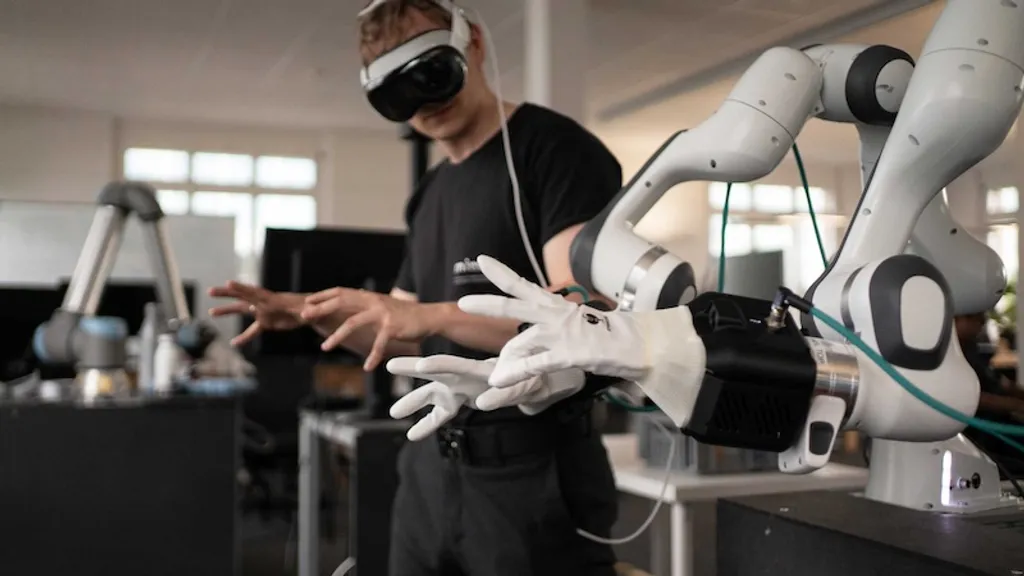
mimic trained FLUX-mimic on data from what it describes as “100+ real factory use cases,” collected as a mix of teleoperated demonstrations on mimic’s own robots and data from mimic’s own wearable capture rig, U1 — the glove-and-headset system visible in this story’s cover photo, teleoperating a robot fitted with mimic’s own dexterous gripper, the mimic hand M1. That matters for one reason: every public deployment example runs on mimic’s own robot and gripper. Neither company’s materials show FLUX-mimic controlling a third-party industrial arm, so whether the approach transfers to other brands’ hardware is, for now, untested in public.
Sources
- Introducing FLUX-mimic: Scaling Video-Action Models for General Purpose Dexterity — mimic robotics, Jul 23, 2026
- FLUX 3 x mimic: The Next Generation of Video-Action Models — Black Forest Labs, Jul 23, 2026
- mimic robotics introduces 'frontier video-action models' to the factory floor at Audi — Robotics and Automation News, Jul 29, 2026
Frequently asked questions
What is a Video-Action Model, and how is it different from a Vision-Language-Action model? +
A Vision-Language-Action (VLA) model starts from a vision-language backbone trained on static images and text, then has to learn physical dynamics almost entirely from scarce, expensive robot demonstration data. A Video-Action Model (VAM) starts from a video-generation backbone that already predicts how a scene evolves frame to frame — mimic robotics and Black Forest Labs' framing is that the same physical understanding a model needs to generate a convincing video of an object being handled is the understanding it needs to actually handle that object, so an action decoder can be trained on top of that video backbone rather than built from scratch.
Is the 95% success rate an independently verified figure? +
No — it's a benchmark mimic robotics ran itself, reported in its own blog post, on a soft-body kitting task on its own robot. mimic says FLUX-mimic hit 95% success with no task-specific fine-tuning, against 55% for an adapted pi0.5 baseline and 70% for a heavily post-trained Flow Matching baseline. No independent lab or third party has published a replication of this benchmark.
Does FLUX-mimic run on Audi's existing robot arms, or on mimic's own hardware? +
Based on mimic's own materials and photos, the deployments shown are on mimic's own robot platform and its own dexterous gripper (the mimic hand M1), operated via mimic's teleoperation wearable (U1) during data collection. Neither company's public materials show FLUX-mimic running on a third-party industrial arm, so it isn't yet established whether the model generalizes to other manufacturers' hardware.
How fast can FLUX-mimic be adapted to a new task? +
mimic and Black Forest Labs say a specific manipulation task can be fine-tuned with as little as 30 minutes of robot-specific data, compared with 30-plus hours for prior Vision-Language-Action approaches — cutting deployment cycles "from months to weeks," per Robotics and Automation News. That figure is separate from the 95% benchmark number above; the two should not be conflated.
More news