Robot Orders Rise 4.3% in Q2 as Electronics, Cobots Lead
North American robot orders rose 4.3% in units, 21.3% in value in Q2 2026 as electronics and life sciences offset automotive OEM's decline, per A3.
North American companies ordered 8,940 robots worth $622 million in the second quarter of 2026, the Association for Advancing Automation (A3) reported August 11 — a 4.3% increase in units and a 21.3% jump in order value versus Q2 2025. The unit growth is modest; the revenue growth isn’t, and that gap is the story: buyers are ordering pricier, more capable systems, concentrated increasingly outside the automotive plants that have anchored this market for decades.
A3 is the North American trade association for the robotics, machine vision, and motion-control industries; its member OEMs and integrators supply the order data behind this quarterly report, which has run since the 1980s and functions as the industry’s closest thing to an official scoreboard — new robot orders, not shipments or installed base, as a leading indicator of where manufacturers are putting capital. Second-quarter results bring first-half 2026 totals to 17,995 units valued at $1.166 billion, up 2.0% in units and 6.6% in order value over the first half of 2025.
Electronics and life sciences pull ahead of automotive
The sector breakdown is where the real news sits. A3’s first-half year-over-year figures by industry: Semiconductor & Electronics/Photonics up 35% in units, Life Sciences/Pharma/Biomed up 32%, Automotive Component up 24%, Food & Consumer Goods up 17%, Plastics & Rubber and All Other Industries both up 6%, Metals up 3%. One sector shrank — Automotive OEM, down 25% for the half, the only category in decline.
Q2-only figures move the same direction at different magnitudes: Semiconductor & Electronics/Photonics up 38%, Automotive Component up 20%, Food & Consumer Goods up 18%, Metals up 18%, Life Sciences/Pharma/Biomed up 9%. A3’s Q2-only breakout doesn’t restate Automotive OEM separately, leaving the first-half -25% as the clearest read on that segment. Non-automotive customers accounted for 56% of all robot units ordered in the quarter — automotive is no longer where most of this market’s unit volume goes.
Cobots hold a steady, growing slice — off a smaller base than Q1’s headline
Collaborative robots — arms built to work alongside people without full fencing — logged 2,774 units worth $114 million in the first half of 2026, 15.4% of all units and 9.8% of order value. In Q2 alone, cobots were 1,137 units and $44 million, 12.7% of units and 7.1% of revenue. They punch well above that overall share inside the two fastest-growing industries: cobots made up 43.7% of Life Sciences’ first-half orders and 36.5% of Semiconductor & Electronics’ first-half orders, meaning the sectors leading this recovery are disproportionately buying the smaller, more flexible robot class over large fixed-automation arms. Readers evaluating specific collaborative robot platforms should treat these as A3’s own analysis of member-reported data, not an independently re-derived figure.
A gentler version of Q1’s story, not a worse one
Industrial Robotics Hub covered A3’s first-quarter 2026 numbers on the same beat three weeks ago: Q1’s order count was essentially flat year over year, but Automotive OEM orders had collapsed 35.1% in units — the steeper of the two automotive pullbacks — while cobots grew 55.6% in units and 78.2% in revenue, the fastest expansion A3 tracked that quarter. Set beside Q2’s figures, without mixing the two quarters’ numbers, the trend eased rather than deepened: Automotive OEM’s decline narrowed to a first-half 25%, and overall order growth flipped from roughly flat to positive 4.3%/21.3%. Cobots stay a strong, rising share of the order book — 15.4% of first-half units — though this release frames that strength through mix and revenue share rather than a Q1-style growth percentage, so the two quarters aren’t directly comparable rate-for-rate. The direction agrees either way: automotive OEM buyers are ordering fewer robots, and a broader set of industries is ordering more.
“The first half of 2026 shows how the mix of the robotics market continues to evolve,” said Alex Shikany, Executive Vice President at A3, in the release. “Automotive remains an important driver of demand, while we’re also seeing growth across a wider range of industries. Results were not uniform across every sector, but the breadth of growth outside Automotive OEM is an important trend we’ll continue to watch.”
The macro backdrop A3 points to
A3’s release ties the order data to two macro signals: the US manufacturing PMI stayed in expansion territory for a sixth consecutive month in June 2026, and Federal Reserve data showed manufacturing output 1.1% above its year-earlier level that same month. Neither is robotics-specific, but both point the same direction as the order data — a manufacturing base still expanding capacity, even with its largest historical robot buyer pulling back.
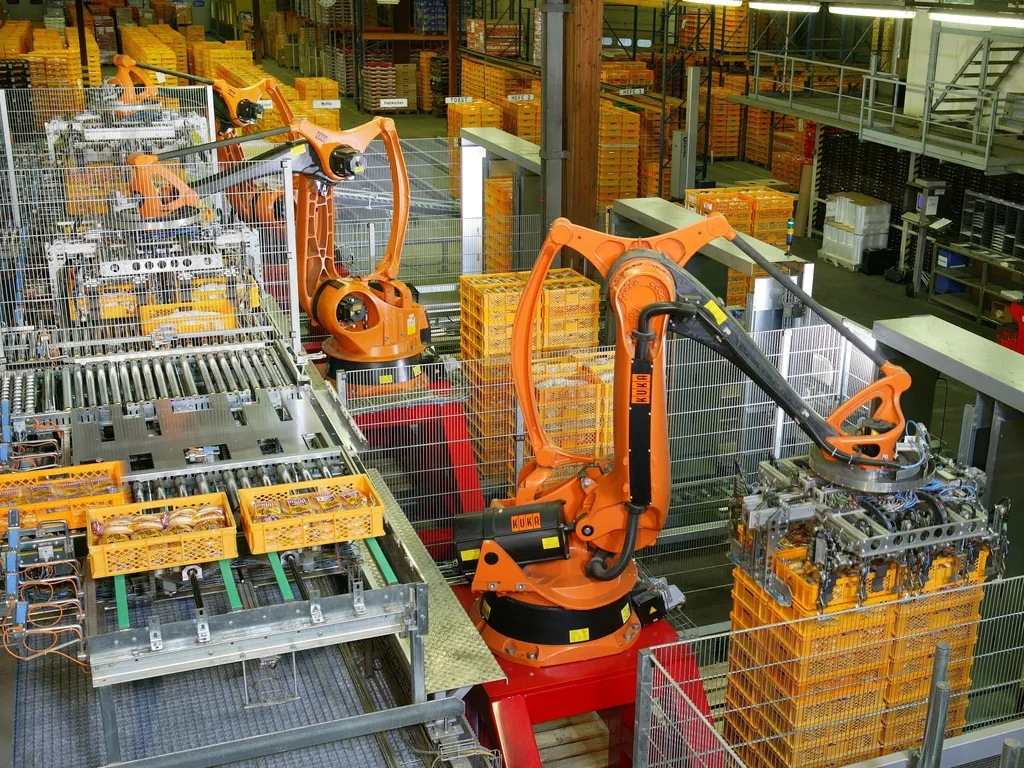
The cover image above, a pair of KUKA arms palletizing bread crates in a bakery warehouse, isn’t tied to any specific order in this report — no robot model or customer deal is named in A3’s release — but it illustrates the kind of high-throughput, non-automotive material-handling work that now represents a majority of what gets ordered in North America. Readers comparing precision needs across these growing sectors may find IRH’s electronics-vs-automotive precision comparison useful context for why semiconductor buyers often specify different robot classes than automotive plants do.
Sources
- Robot Orders Increase in Q2 as Automation Demand Broadens Across Industries — Association for Advancing Automation (A3), Aug 11, 2026
- Robot Orders Increase in Q2 as Automation Demand Broadens Across Industries — RoboticsTomorrow, Aug 11, 2026
- A3: Robot Orders Increase in Q2 as Automation Demand Broadens Across Industries — Robotics 24/7, Aug 11, 2026
Frequently asked questions
Why did electronics overtake automotive as the growth driver in H1 2026? +
A3's own data shows Semiconductor & Electronics/Photonics orders up 35% in units for the first half of 2026, the fastest of any sector, while Automotive OEM orders fell 25% — the only declining category. A3 does not spell out the exact cause in the release, but the pattern lines up with the broader AI/data-center capex buildout, which depends heavily on semiconductor fabrication and packaging capacity that itself needs automation to scale.
What does the 56% non-automotive order share actually mean? +
It means that in Q2 2026, for the first time this report highlights explicitly, more than half of all North American robot units ordered went to buyers outside the automotive industry. Automotive — OEMs and their component suppliers combined — has historically been the largest single buyer category in North American robotics, so a majority-non-automotive quarter marks a real shift in who is actually buying robots, not just a rounding blip.
Is Q2 2026 a better or worse quarter than Q1 2026 for robot orders? +
By the headline numbers, better. Q1 2026 orders were essentially flat versus Q1 2025 (-0.1% in units, -6.4% in revenue), with Automotive OEM down a steep 35.1%. Q2 2026 grew 4.3% in units and 21.3% in revenue year over year, and the Automotive OEM decline eased to 25%. The broad direction — automotive weak, most other sectors strong — held across both quarters, but the second quarter's numbers are stronger on every axis A3 reports.
What's the risk if AI-driven semiconductor and data-center capex slows down? +
Electronics and semiconductor manufacturing is now the single largest driver of order growth in this report, which cuts both ways: it has offset a genuine automotive downturn, but it also means a growing share of the robotics order book is now tied to the capital-spending cycle of an industry itself dependent on AI infrastructure demand. If chipmakers or contract electronics manufacturers pull back capex — because AI spending cools, memory pricing turns, or fab capacity gets ahead of demand — the sector currently propping up the market's growth rate would be the one to pull it back down.
More news