Articulated Robots by Payload and Reach: 94 Down to 1
94 of 174 articulated robots clear 20 kg and 1,500 mm reach together. Just 1 clears 1,000 kg and 3,500 mm, a 94x collapse across 5 brackets.
94 of 174 articulated robots in our database clear 20 kg payload and 1,500 mm reach at the same time. Push the target to 1,000 kg and 3,500 mm and exactly one robot clears it. That is a 94x collapse across five buyer-realistic brackets, and it is steeper than the same test run on cobots.
We ran this exercise on collaborative robots last month (cobot selection by payload and reach), where the top bracket fell from 118 robots to 8, a 14.75x drop. Articulated arms fall much harder, because they span a vastly wider payload range than cobots do, from sub-1 kg tabletop units to 1,700 kg foundry arms. A buyer asking “which robot can lift X at Y millimeters of reach” gets a very different answer depending on which end of that range they’re shopping.
How many articulated robots clear a heavy-duty payload and reach target?
We pulled every articulated robot in the Industrial Robotics Hub database (non-cobot, non-SCARA, non-delta) and checked how many publish both payloadKg and reachMm. 174 of 176 do, 98.9% coverage, unusually complete for a spec pair that many manufacturers leave off a datasheet.
We then ran five combined targets, each requiring a single model to clear both numbers at once, not one spec on one SKU and the other spec on a different SKU:
| Payload threshold | Reach threshold | Qualifying robots | % of 174 |
|---|---|---|---|
| 20 kg | 1,500 mm | 94 | 54.0% |
| 50 kg | 2,000 mm | 70 | 40.2% |
| 165 kg | 2,500 mm | 43 | 24.7% |
| 500 kg | 3,000 mm | 4 | 2.3% |
| 1,000 kg | 3,500 mm | 1 | 0.6% |
Source: Industrial Robotics Hub database, 174 articulated robots publishing both payload and reach, live query 2026-08-18.
The steepest single step is between the 165 kg/2,500 mm and 500 kg/3,000 mm brackets, 43 robots down to 4, a 90% loss in one jump. Below that line, a buyer is comparing catalogs. Above it, they’re checking whether anything exists at all.
This is a fundamentally different shape than what we found running the same test on cobots. There, the top bracket (30 kg/1,700 mm) still had 8 qualifying robots across 6 brands. Here, the top bracket has 1 robot from 1 brand. Articulated arms don’t taper toward the extreme tier, they nearly vanish.
Which robot brands actually compete at the top of the market?
Of the 20 brands in our database, 14 build at least one articulated arm. Six are cobot-only and build none: AUBO, Dobot, Doosan, Han’s Robot, Techman, and Universal Robots. That’s consistent with what we found in our brand-breadth analysis: these are the same five or six brands that stick to one architecture rather than spreading across the catalog.
Building an articulated arm at all is one filter. Building one that clears the mid-tier 165 kg/2,500 mm bracket is a second, tighter filter. Only nine of the fourteen articulated-building brands have a model there:
| Brand | Robots in 165 kg / 2,500 mm bracket |
|---|---|
| ABB | 13 |
| Estun | 9 |
| Siasun | 6 |
| FANUC | 4 |
| Kawasaki | 3 |
| KUKA | 3 |
| Yaskawa | 3 |
| Rokae | 1 |
| Staubli | 1 |
ABB alone accounts for nearly a third of that bracket (13 of 43), which tracks with ABB’s long-standing heavy-industrial IRB lineup. But move up one more bracket, to 500 kg and 3,000 mm, and the field narrows from nine brands to three: ABB, FANUC, and KUKA. Only they have a model that clears both numbers together.
The four robots that qualify:
- ABB IRB 8700-550/4.2 (/robots/abb/abb-irb-8700/), 550 kg payload, 4,200 mm reach
- FANUC M-1000iA (/robots/fanuc/fanuc-m-1000ia/), 1,000 kg payload, 3,253 mm reach
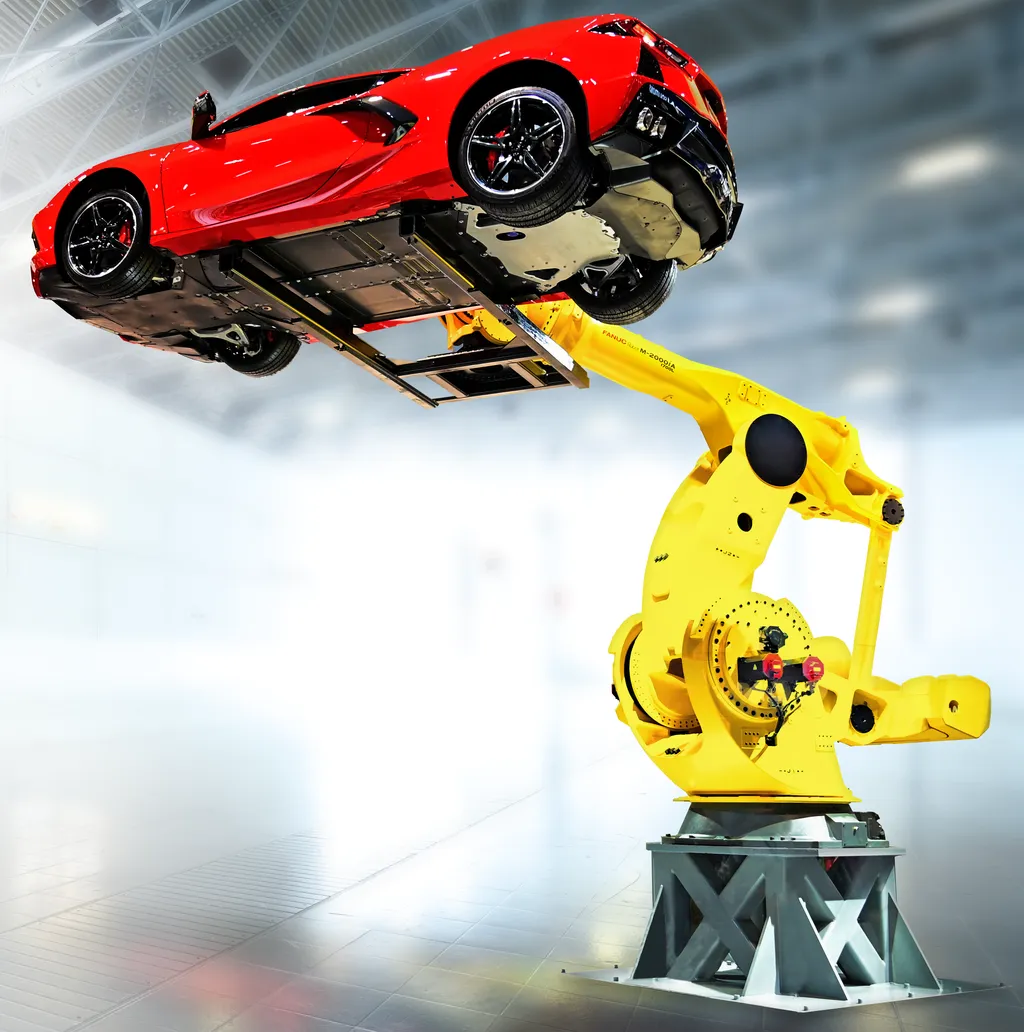
- FANUC M-2000iA/1700L (/robots/fanuc/fanuc-m-2000ia-1700l/), 1,700 kg payload, 3,734 mm reach
- KUKA KR 1000 TITAN (/robots/kuka/kuka-kr-1000-titan/), 1,000 kg payload, 3,202 mm reach
Eleven of the fourteen articulated-building brands, including Estun, Siasun, Yaskawa, Kawasaki, Rokae, and Staubli, have nothing that clears 500 kg and 3,000 mm simultaneously, even though several of them (Estun, Siasun) place well in the mid-tier bracket. Scale and reach at the extreme end is a different engineering problem than scale alone, and most catalogs stop before they get there.
What does no comparison shopping actually look like?
At 1,000 kg payload and 3,500 mm reach, the field collapses to exactly one robot in the entire 400-robot database: the FANUC M-2000iA/1700L, rated at 1,700 kg payload and 3,734 mm reach (/robots/fanuc/fanuc-m-2000ia-1700l/).
This isn’t the first time this specific robot has shown up as our extreme-payload outlier. It anchored the top end of our payload-vs-reach frontier analysis, our power-efficiency piece, and our wrist-torque-to-payload post. We want to be honest about what that repetition means: it is not evidence that FANUC “dominates” the extreme tier. It’s a small-sample fact about this catalog, one robot happens to be the only one published past this combined threshold. No other brand has a competing model in the database, not because FANUC out-engineered everyone, but because almost nobody else builds this far up the payload-and-reach curve in the first place.
That’s the interesting fact for a buyer shopping in that tier, not who wins, but that there is no “who wins” question to ask. A buyer targeting 1,000 kg and 3,500 mm together isn’t doing competitive procurement. They’re qualifying whether one specific arm physically fits their cell, because there is nothing else in this catalog to compare it against.
What does this mean for buyers shopping the extreme tier?
The two ends of the articulated-arm market behave like two different products.
Below 165 kg and 2,500 mm, a buyer has real choice. Nine or more brands compete in most of the lower brackets, and at the 20 kg/1,500 mm floor, more than half the articulated catalog (54.0%) qualifies. That’s a normal RFP process: multiple vendors, comparable specs, room to negotiate on price and lead time.
Past 500 kg and 3,000 mm, the field narrows to three brands and four robots. Past 1,000 kg and 3,500 mm, it narrows to one robot from one brand. There is no RFP at that tier in the meaningful sense. There’s one candidate, and the buying decision becomes a fit check: does this specific arm’s reach envelope, mounting footprint, and controller ecosystem work in this specific cell, not “which vendor should we choose.”
It’s worth putting this next to what we found on the cobot side. There, Universal Robots, the market’s order-share leader, had zero model clearing the top bracket (30 kg and 1,700 mm together) despite having two separate near-miss SKUs that each cleared one axis alone. Here, the mirror image: one single robot from one single brand IS the entire top bracket, with no near-misses from anyone else in the catalog. Two very different failure modes for a buyer, but the same lesson underneath. Don’t assume the middle of a spec sheet predicts the top. Check the combined bracket you actually need, not the brand’s reputation or its mid-range lineup, before you commit budget to a heavy-duty cell.
For a wider view of how payload and reach trade off across the whole catalog rather than just at these five brackets, see our payload-vs-reach frontier analysis, which looks at efficiency (grams of payload per millimeter of reach) rather than combined thresholds. Different framing, same underlying dataset, worth reading alongside this one if you’re mapping out where a candidate arm sits relative to the rest of the articulated robot category.
Compare these robots