The Smallest Industrial Robots: 45 Tabletop-Class Arms Under 600mm Reach
45 of the 336 robots in our database reach 600mm or less, and the lightest one isn't a cobot at all. Here's what actually fits on a bench, ranked by reach, payload, and weight.
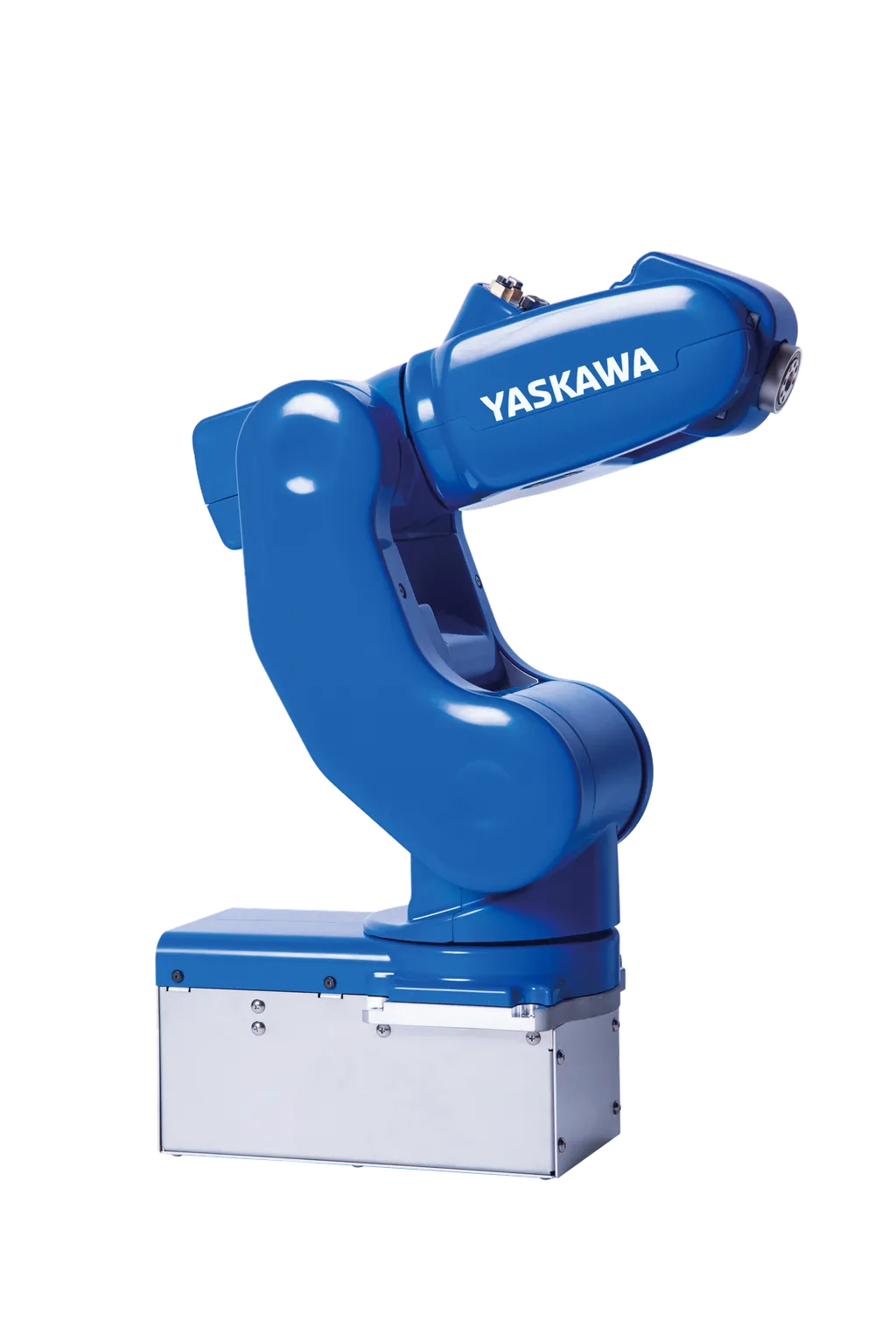
Forty-five of the 336 robots in our database reach 600mm or less, small enough to work inside a benchtop cell instead of a fenced floor bay. The lightest one in that group, and the lightest robot arm we track at any size, is not a cobot. It’s a 7kg industrial arm from Yaskawa that predates the cobot category by a decade. If you’re sizing a robot for a workspace measured in square feet instead of square meters, the shortlist looks different than the marketing usually suggests.
What counts as tabletop-class in our database
We filtered all 329 robots that publish a reachMm figure (329 of 336, 97.9% coverage) down to those at 600mm or less, the rough threshold where an arm stops needing a floor footprint and starts fitting on or beside a workbench. That leaves 45 robots across 17 brands. SCARA arms dominate the class, 22 of 45 (48.9%), because the format was built for exactly this job, flat pick-and-place and screwdriving work in a small envelope. Traditional articulated arms hold 14 (31.1%), cobots 8 (17.8%), and there’s a single delta robot, FANUC’s M-1iA/0.5S.
Source: performance.reachMm and robotType, all 336 robots in src/content/robots/*.json, filtered to reachMm <= 600 and status: active.
Payload across the whole group runs 0.5kg to 10kg, the range you’d expect for electronics, small-parts assembly, and light dispensing rather than case handling. Application tags back that up directly: 43 of 45 (95.6%) are tagged for assembly, 37 (82.2%) for pick-and-place, 23 for inspection, and 21 for dispensing. Only 3 carry a packaging tag and just 2 are tagged for welding. This is an assembly-and-inspection class of robot, not a general-purpose one.
The lightest robot we track isn’t a cobot
Yaskawa’s MotoMINI weighs 7kg, the lowest weight figure of any of the 336 robots in our database, cobot or not. It’s a conventional six-axis articulated arm, not power-and-force-limited, with a 350mm reach and a 0.5kg payload built for micro-assembly and small-parts handling on a bench. It undercuts every cobot in our tabletop shortlist on weight, including JAKA’s MiniCobo (8.7kg) and ABB’s single-arm YuMi IRB 14050 (9.5kg), both of which are purpose-built collaborative designs.
That’s a useful correction to the assumption that “small and light” automatically means “collaborative.” Weight and reach in this class track the mechanical design more than the safety category: a small conventional arm behind light guarding can end up lighter than a small cobot carrying the extra sensing and compliant joints that let it work fenceless.
Why the smallest-reach robot isn’t the lightest
FANUC’s M-1iA/0.5S has the shortest reach of anything in our database, 280mm, and a payload of just 0.5kg. It also weighs 20kg, more than several arms with double its reach, including the MotoMINI (350mm, 7kg) and Dobot’s MG400 (440mm, 8kg). The reason is structural, not a fluke: the M-1iA is a delta robot, and delta arms carry their motors and drivetrain in a fixed overhead frame rather than distributing mass down a serial arm. That frame adds weight independent of how far the tooling reaches, which is also why delta robots dominate high-speed, small-envelope pick tasks (see our SCARA vs. delta vs. 6-axis breakdown) rather than showing up as the “lightest” option on a spec sheet.
The lesson for a buyer comparing datasheets: reach and weight don’t move together in a straight line, and the mounting geometry (serial arm vs. parallel/delta frame) matters more than the headline reach number when you’re trying to figure out what will physically fit and how much the mount needs to support.
The full shortlist, sorted by reach
| Model | Brand | Type | Reach (mm) | Payload (kg) | Weight (kg) |
|---|---|---|---|---|---|
| M-1iA/0.5S | FANUC | delta | 280 | 0.5 | 20 |
| MELFA RH-3FRH | Mitsubishi Electric | scara | 300 | 3 | 8 |
| G3 | Epson Robots | scara | 350 | 3 | 14 |
| IR-TS4-35Z15S-INT | Inovance | scara | 350 | 4 | 18.5 |
| MotoMINI | Yaskawa Motoman | articulated | 350 | 0.5 | 7 |
| IRB 1010 | ABB Robotics | articulated | 370 | 1.5 | 13.5 |
| LS3-B | Epson Robots | scara | 400 | 3 | 14 |
| T3 | Epson Robots | scara | 400 | 3 | 16 |
| SR-3iA | FANUC | scara | 400 | 3 | 19 |
| IR-S4-40Z15S3 | Inovance | scara | 400 | 4 | 12 |
| SA4A | Siasun | scara | 400 | 4 | 13 |
| MG400 | Dobot | cobot | 440 | 0.75 | 8 |
| IRB 910SC-3/0.45 | ABB Robotics | scara | 450 | 3 | 25 |
| Flexion N2 | Epson Robots | articulated | 450 | 2.5 | 19 |
| TS2-40 | Stäubli Robotics | scara | 460 | 8.4 | 38 |
| ER3-500-SR | Estun | scara | 500 | 3 | — |
| IR-S7-50 | Inovance | scara | 500 | 7 | 17 |
| UR3e | Universal Robots | cobot | 500 | 3 | 11.2 |
| MELFA RV-2FR | Mitsubishi Electric | articulated | 504 | 2 | 18 |
| MELFA RV-4FR | Mitsubishi Electric | articulated | 515 | 4 | 22 |
| TX2-40 | Stäubli Robotics | articulated | 515 | 2 | 29 |
| KR 3 AGILUS | KUKA | articulated | 541 | 3 | 26.5 |
| IR-R4H-54S-INT | Inovance | articulated | 546 | 4 | 24.5 |
| IRB 920-6/0.55 | ABB Robotics | scara | 550 | 6 | 27 |
| ER4-550-MI | Estun | articulated | 550 | 4 | 22 |
| IR-TS5-55Z15S-INT | Inovance | scara | 550 | 5 | 20 |
| YuMi IRB 14000 (dual-arm) | ABB Robotics | cobot | 559 | 0.5 | 38 |
| YuMi IRB 14050 (single-arm) | ABB Robotics | cobot | 559 | 0.5 | 9.5 |
| IR-R4-56S5 | Inovance | articulated | 561 | 4 | 24 |
| IRB 1100 | ABB Robotics | articulated | 580 | 4 | 21 |
| SWIFTI CRB 1100-4/0.58 | ABB Robotics | cobot | 580 | 4 | 21 |
| MiniCobo | JAKA | cobot | 580 | 1 | 8.7 |
| SN4A | Siasun | articulated | 580 | 4 | 22 |
| Elfin E03 | Han’s Robot | cobot | 590 | 3 | 18 |
| CL103N | Kawasaki Robotics | cobot | 590 | 3 | — |
| XB4 | ROKAE | articulated | 596 | 4 | 32 |
| C4 | Epson Robots | articulated | 600 | 4 | 27 |
| LS10-B | Epson Robots | scara | 600 | 10 | 22 |
| T6 | Epson Robots | scara | 600 | 6 | 22 |
| ER10-600-SR | Estun | scara | 600 | 10 | 23 |
| IR-S10-60Z20S-INT | Inovance | scara | 600 | 10 | 18.5 |
| KR SCARA R600 | KUKA | scara | 600 | 8 | 56 |
| MELFA RH-6FRH | Mitsubishi Electric | scara | 600 | 6 | 15 |
| eCobra 600 | OMRON Robotics | scara | 600 | 5.5 | 24 |
| TS2-60 | Stäubli Robotics | scara | 600 | 8 | 21 |
Source: performance and physical.weightKg, all 45 robots, src/content/robots/*.json. Weight coverage is 43 of 45 (95.6%); two models, Estun’s ER3-500-SR and Kawasaki’s CL103N, don’t yet publish a weight figure and are shown as ”—” rather than estimated.
Note the KUKA KR SCARA R600 outlier at the bottom: 600mm reach, the same as several arms weighing half as much, but 56kg, the heaviest robot in the whole shortlist by a wide margin. It’s built on a heavier-duty base than the rest of the compact-SCARA field, worth checking before assuming every 600mm-class arm needs the same bench or stand.
Mounting flexibility: floor isn’t the only option
Floor mounting is still the default, 43 of 45 (95.6%) support it, but a meaningful share of this class can also be hung. 25 of 45 (55.6%) support ceiling mounting and 16 (35.6%) support wall mounting, with 6 supporting a tilted mount. For a buyer genuinely tight on floor space, that matters more than it sounds: a ceiling- or wall-mounted arm working over or beside a fixture can shrink the footprint further than a floor-mounted arm of the same reach, at the cost of needing structural support built into the cell rather than just a stand. Check our robot mounting options guide before assuming floor is the only path.
What a compact class actually buys you
None of the 45 robots here publish a footprintMm figure in our database (a gap across almost the entire 336-robot catalog, not specific to this class), so we’re not claiming a per-model base-plate size. What the reach and weight data does support is directional: per our floor-space-by-type analysis, swept work area scales with the square of reach, so a 500mm-reach arm sweeps roughly a quarter of the area a 1000mm arm does, before any clearance is added. Cutting reach in half is closer to a 4x floor-area reduction than a 2x one. That’s the real argument for a tabletop-class robot over a downsized general-purpose arm: the space savings compound faster than the reach number suggests.
Cost tracks a similar logic industry-wide. External market data puts a typical SMB cobot deployment at roughly $10,000 to $50,000 for the arm itself, with lightweight 3 to 5kg payload classes and Universal Robots’ own compact UR3e (500mm reach, 3kg payload, in this shortlist) frequently cited as a standard benchtop entry point for tight workspaces (Standard Bots, Universal Robots). We don’t hold pricing data ourselves, all our listings are “price on application,” so treat that range as external context, not a number to quote against any specific model here.
Choosing between the shortlist and a full-size arm
If your part or product weighs under roughly 10kg and the robot never needs to reach past 600mm to do the job, this shortlist is the field to shop from rather than a downsized version of a full industrial arm. Assembly, pick-and-place, inspection, and dispensing cover 96% of the applications tagged across these 45 robots, so if your task falls outside that set, especially anything closer to machine tending, material handling, or heavier packaging, check the broader reach-by-type comparison and cobot vs. industrial robot guide before narrowing to a compact arm on reach alone. SCARA remains the default format for this class for a reason: it was purpose-built for exactly the flat, repetitive, small-envelope work that dominates the application tags here, and 22 of the 45 tabletop-class robots we track are SCARA arms.
Sources: Standard Bots — small industrial robot arms, Universal Robots — UR3e.
Compare these robots