One Robot Series Spans 150x the Payload
A product-family name is how manufacturers market, quote and train, so buyers standardise on it. But inside one named series in our 355-robot database the payload spans up to 150x, the arm mass 108x and the repeatability 10x, and the IP rating can fall from IP67 to IP30.
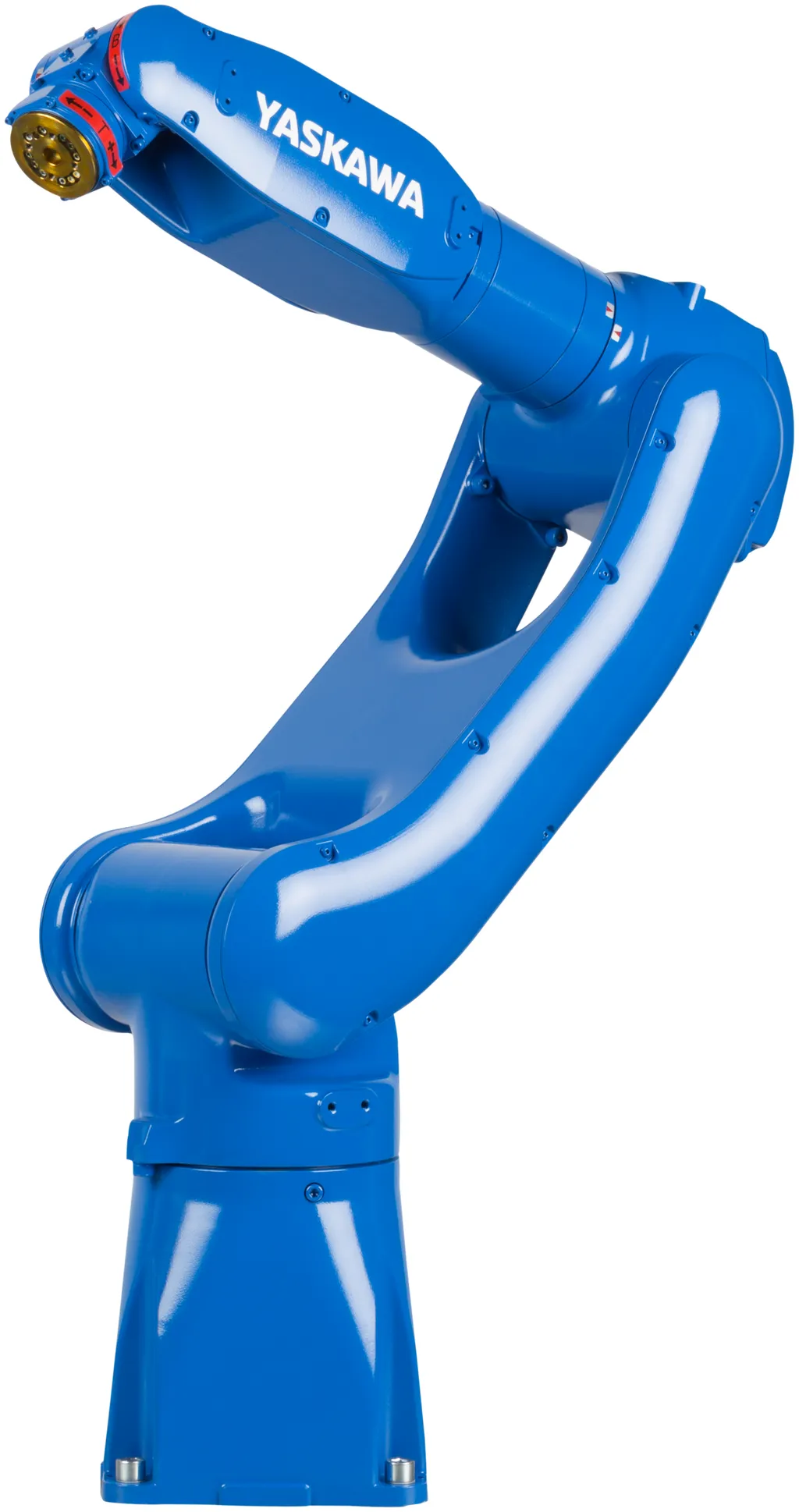
If you standardise on a robot “series”, you have standardised on less than you think. Of the 355 robots in the Industrial Robotics Hub database, 307 (86.5%) carry a manufacturer product-line name, spread across 136 distinct families. In the 35 families that contain three or more models, the median payload span inside a single named series is 6x. The widest, Yaskawa’s GP Series, runs from a 4 kg arm to a 600 kg arm, a 150x spread, with a 108x spread in arm mass and a 10x spread in repeatability along the way. The family name is a reliable guide to kinematic class and software environment. It is not a spec, and it is not a compatibility promise.
What a product family actually is in the data
A product line is the label the manufacturer prints above a group of models: GP Series, CRX, KR AGILUS, TX2, ER. It is how robots are marketed, how distributors quote, how training courses are organised, and how most plants describe their installed base. It is also, in our data, mostly a very small group.
| Family size | Families | Robots covered |
|---|---|---|
| 1 model only | 83 | 83 |
| 2 models | 18 | 36 |
| 3 or more models | 35 | 188 |
| Total with a named line | 136 | 307 of 355 (86.5%) |
The 35 multi-model families are where the buying behaviour concentrates: 188 robots, 52.9% of the whole catalog. Those are the series a plant is realistically standardising on, and those are the ones this analysis covers. The 48 robots with no product-line name at all come almost entirely from four brands that do not group their lineups this way: Siasun (19), Omron (11), Inovance (9) and Techman (8).
The payload spread inside one name
Here is the span between the smallest and largest payload inside a single named series, for the ten widest families in the database:
Even the tightest families are not tight. Only four of the 35 come in under a 2x payload span: Stäubli’s TS2 SCARA line (8 to 8.4 kg), Yaskawa’s AR welding series (7 to 12 kg), ROKAE’s XB line (4 to 7 kg) and Doosan’s A Series (5 to 9 kg). The other 31 ask the buyer to hold in mind that “same series” covers at least a doubling of capability.
The Yaskawa GP Series, model by model
The extreme case is worth walking through in full, because every column tells a different part of the story. All ten of these robots are sold under one name. This is the whole family as our database has it:
| Model | Payload | Reach | Arm mass | Repeatability | Arm IP |
|---|---|---|---|---|---|
| GP4 | 4 kg | 550 mm | 28 kg | 0.01 mm | — |
| GP7 | 7 kg | 927 mm | 34 kg | 0.01 mm | IP67 |
| GP12 | 12 kg | 1,440 mm | 150 kg | 0.02 mm | IP67 |
| GP25 | 25 kg | 1,730 mm | 250 kg | 0.02 mm | IP67 |
| GP50 | 50 kg | 2,061 mm | 570 kg | 0.03 mm | IP67 |
| GP70L | 70 kg | 2,732 mm | 650 kg | 0.05 mm | IP54 |
| GP88 | 88 kg | 2,236 mm | 630 kg | 0.03 mm | IP67 |
| GP180 | 180 kg | 2,702 mm | 1,020 kg | 0.05 mm | IP67 |
| GP280 | 280 kg | 2,446 mm | 1,300 kg | 0.05 mm | IP67 |
| GP600 | 600 kg | 2,942 mm | 3,035 kg | 0.1 mm | IP30 |
Corrected 20 September 2026: the GP4 and GP70L reach figures were previously listed as their vertical reach (1,008 mm and 4,715 mm); the horizontal reach per Yaskawa’s datasheets (550 mm and 2,732 mm) is shown, matching the other models in this table.
Read down the last two columns rather than the first. Repeatability degrades by a factor of ten from the GP4 to the GP600, which is the difference between a precision assembly arm and a heavy handling arm. Arm mass rises by a factor of 108, which is the difference between bolting to an existing slab and pouring a new one, as covered in our robot weight and floor-loading breakdown. And the arm IP rating drops from IP67, sealed against temporary immersion, to IP30 on the GP600, which is essentially finger protection and no water rating at all.
None of those transitions are faults. A 600 kg press-tending arm has no business being sealed to IP67, and 0.1 mm is a perfectly good number at that scale. The point is that they all happen under one name, so a specification that says “Yaskawa GP Series” has pinned nothing that matters.
What changes inside a family, and how often
Four attributes are worth checking explicitly whenever a model is being swapped for a sibling. Counting only the families where every single model publishes the field, so the percentages are not inflated by missing data:
| Attribute | Families checked | Not consistent inside the family |
|---|---|---|
| Arm IP rating | 32 | 9 (28%) |
| Repeatability (2x spread or worse) | 32 | 20 (63%) |
| Controller platform | 32 | 5 genuine splits |
| Robot type | 53 | 0 |
IP rating. KUKA’s KR AGILUS is IP54 across five models and IP40 on the KR 4 R600. Estun’s ER Mini line carries three different ratings across five models (IP54, IP65 and IP67). Estun’s ER SCARA family spans IP20 to IP54. If your cell has coolant mist or washdown-adjacent duty, the family name is not the thing to check, the per-model rating is, and our IP rating guide explains why the arm and wrist figures can also differ from each other.
Repeatability. Twenty of the 32 fully-covered families spread by 2x or more. That includes families a buyer would expect to be homogeneous: Hans Robot’s Elfin cobots run 0.02 to 0.1 mm, AUBO’s i-series the same. Standardising on a family and assuming an accuracy class is the most common version of this mistake, and it usually surfaces at commissioning. Our repeatability by type breakdown has the context for what those numbers mean in practice.
Controller. This is the expensive one. Five families genuinely split across controller hardware. KUKA’s KR AGILUS runs the KR C5 micro on five models and the full-size KR C5 on the KR 20 R1810. Epson’s LS-B SCARA line puts the LS3-B, LS10-B and LS20-B on the RC90-B and the LS6-B on an RC700-E. JAKA’s A series manages four different cabinets across four models: CAB 7, CAB 12, CAB 16 and CAB L. ABB’s YuMi spans an integrated IRC5 on the dual-arm version and OmniCore on the single-arm. A different cabinet means different footprint, different spares, and often different mounting and cabling work. This is the same fragmentation we mapped at brand level in our controller platform analysis, one level further down.
Two more families list two controller names that are only naming variants of the same platform (KUKA’s Sunrise OS and Sunrise.OS, Doosan’s DART Platform and DART Studio), and Yaskawa’s HC Series offers each arm a choice between the YRC1000 and the YRC1000micro rather than fixing one per model. We excluded all three from the count of genuine splits rather than inflate it.
Electrical supply. FANUC’s CRX cobot family is a clean example. The CRX-3iA and CRX-5iA accept 100-120 VAC or 200-240 VAC, while the CRX-10iA, CRX-10iA/L, CRX-20iA/L and CRX-25iA specify 200-240 V single phase. Both halves stay off three-phase, which is the CRX line’s real selling point, but the two halves are not the same install. Our three-phase power breakdown covers why that line item gets forgotten in the first place.
What the family name does reliably tell you
The honest counterweight, because the answer is not “ignore the series”.
Kinematic class is absolute. Of the 53 multi-model families in the database, all 53 are internally consistent on robot type. Not one series mixes a SCARA with an articulated arm, or a cobot with a delta. If a family is cobots, every member is a cobot. That is a genuinely dependable signal, and it is why “we’re a SCARA shop on the Epson G-Series” is a meaningful sentence.
The software environment travels. Of the 49 families where every model publishes its programming methods, 45 use an identical set across the whole series. Your programmers’ skills, the teach pendant workflow, the offline programming package and most of the integration knowledge carry from the smallest member to the largest. That is the actual return on standardising, and it is a real one. It is just a return in training and software, not in interchangeable iron.
Design generation is usually consistent too. A family is generally one design cycle, so staying in-family tends to keep you on a current platform rather than an ageing one, which matters for the parts clock discussed in our model age and support window analysis.
How to use this when you specify
Six lines, and none of them is the series name:
- Exact model designation, including any suffix. The L in a Stäubli TX2-200L is not cosmetic: the TX2-200 lifts 170 kg at 2,209 mm, while the TX2-200L trades down to 110 kg to reach 2,609 mm.
- Payload at your real tool offset, not the catalog number, for the reasons in what a payload rating doesn’t tell you.
- Repeatability, stated per model.
- Arm IP rating, and the wrist rating separately if the tool sees the mess.
- Controller model, named. If the vendor cannot name it, that is the answer.
- Electrical supply, phase and voltage.
If a vendor proposes a substitution “within the same family”, treat it as a different robot and re-check all six. On the numbers above, roughly a quarter of families would fail the IP line alone, and closer to two thirds would fail the repeatability line on a like-for-like swap.
A series name is a good way to choose a supplier relationship. It is a bad way to write a specification.
All figures derived from the Industrial Robotics Hub database of 355 robots as of 28 July 2026. Coverage is stated per attribute, and any family where a model does not publish a given field was excluded from that field’s count rather than assumed. Manufacturer family pages consulted for context: Yaskawa Motoman GP7 and GP600, KUKA KR AGILUS, FANUC America collaborative robot series, Universal Robots e-Series.
Frequently asked questions
Does a robot product series guarantee the models share the same specs? +
No. Across the 35 multi-model families in our 355-robot database, the median payload span inside a single named series is 6x, and the widest is Yaskawa's GP Series at 150x (the GP4 lifts 4 kg, the GP600 lifts 600 kg). Repeatability spreads by 2x or more inside 20 of the 32 families where every model publishes a figure, and IP rating is not consistent inside 9 of those 32. The series name tells you which design language and software environment the arm belongs to, not what it can do.
Can I upgrade to a bigger robot in the same series without changing anything else? +
Usually not, and the family name is what makes people expect otherwise. Moving up inside a series can change the controller cabinet (KUKA's KR AGILUS runs KR C5 micro on five models and the full-size KR C5 on the KR 20 R1810), the electrical supply (FANUC's CRX-3iA and CRX-5iA accept 100-120 VAC while the rest of the CRX line needs 200-240 V), and the floor loading by two orders of magnitude (the Yaskawa GP Series runs from a 28 kg arm to a 3,035 kg arm). The teach program, the tooling interface and the operator training usually do carry over, which is the real value of staying in-family.
What does a robot family name reliably tell you? +
Two things, both worth having. First, kinematic class: of the 53 multi-model families in our database, all 53 are internally consistent on robot type, so a SCARA series is entirely SCARAs and a cobot series is entirely cobots. Second, the programming environment: 45 of the 49 families where every model publishes its programming methods use an identical set across the whole series. That is why standardising on a family still pays, it just pays in software and skills rather than in interchangeable hardware.
Why do manufacturers put such different robots in one series? +
Because a series is organised around a market position and a design generation, not a spec band. Yaskawa's GP Series means general-purpose handling arms of the current generation, which is a category that has to cover a 4 kg parts feeder and a 600 kg press-tending arm. Estun's ER line spans 19 models from 12 kg to 700 kg for the same reason. The name is doing marketing and roadmap work, and it does that job honestly. The mistake is on the buying side, when the name gets read as a compatibility promise.
How should I write a robot into a specification document? +
Name the exact model, not the series, and pin the attributes you actually depend on separately: payload at your real tool offset, reach, repeatability, arm IP rating, controller model and electrical supply. If a vendor proposes a substitution inside the same family, treat it as a different robot and re-check those six lines. Roughly a quarter of the families in our data would fail at least one of them on a like-for-like swap.
Compare these robots