WRC Disclosure Gap Meets IP Escalation as Deployments Scale
Three WRC exhibitors' unaudited claims, Teradyne's second Chinese-cobot suit, and Brightpick's verified fleet growth mark a week of uneven proof.
Three exhibitors at China’s flagship robotics trade show published numbers this week that didn’t hold up under a source check, one European cobot maker escalated a patent fight that could reach 19 countries at once, and a pharmacy-warehouse robot fleet kept scaling on numbers that did hold up. The throughline is a widening gap between what companies say and what a third party can confirm — visible in the same week across a trade show, a courtroom, and a warehouse floor.
Thread 1: A trade show that outran its own verification
WRC 2026 Beijing (Aug. 19-23) drew more than 300 exhibiting companies, and three of them made claims this desk couldn’t verify.
Zoomlion’s Z01 and Z03 humanoids (Aug. 23) demonstrated wire-harness handling and mirror preassembly under a new “Robot Ops” platform. A circulated “2,000+ adaptive robots” figure appears in none of Zoomlion’s own materials — its PR Newswire release, RoboticsTomorrow republish, or newsroom post — and was dropped rather than repeated. What holds up is narrower: “nearly 20 manufacturing scenarios” validated at Zoomlion’s own facility, no throughput or ROI data, no third-party audit.
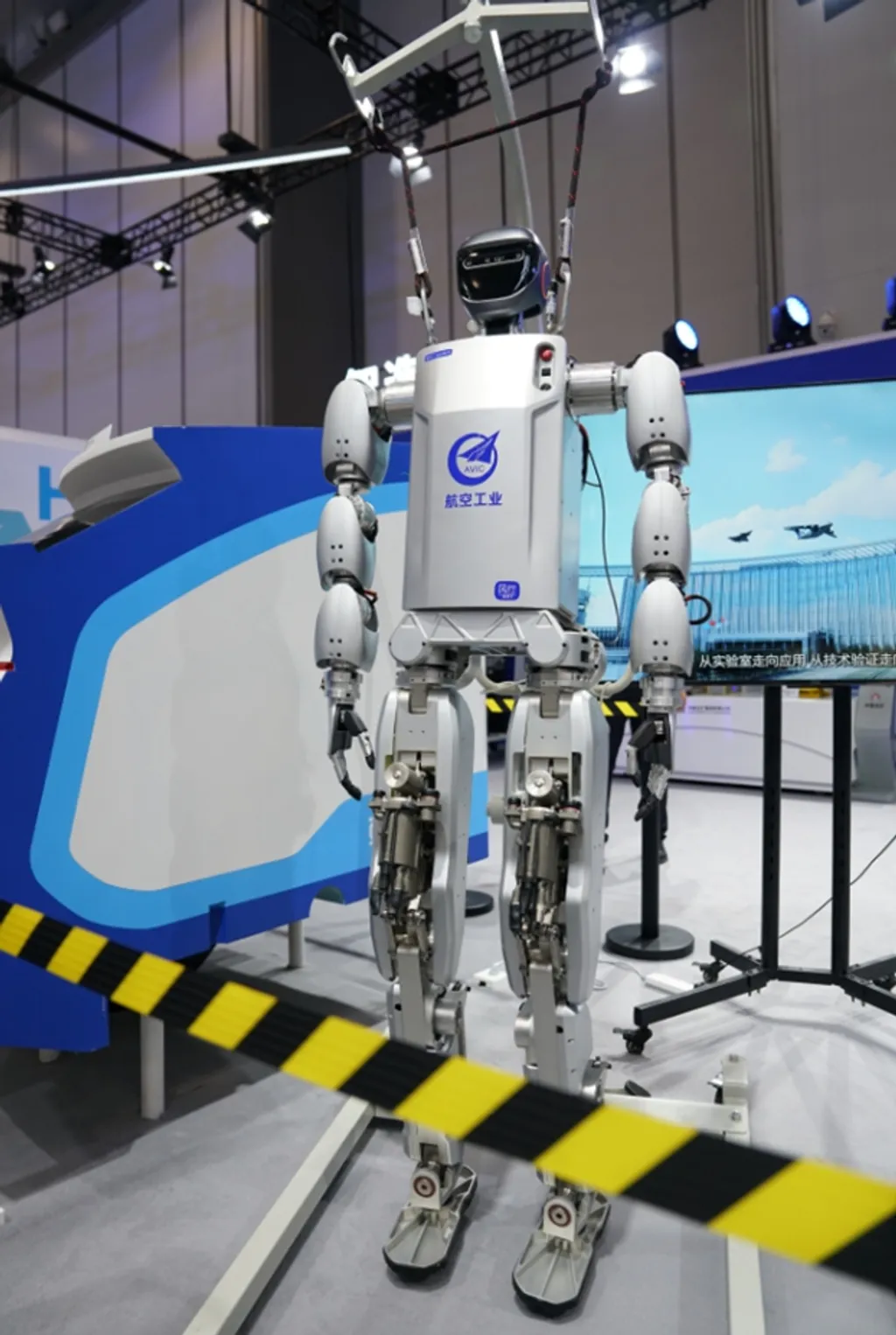
AVIC’s Fengxing-001 (Aug. 23) fared better on hard specs — 1.8 meters, 80 kilograms, a 30cm jump, confirmed verbatim across People’s Daily Online and Global Times — but a circulated “42 active degrees of freedom” figure appears in neither primary source and was omitted too. Worse, the two state outlets can’t agree what task AVIC’s robots replaced workers on: People’s Daily says “missile-loading,” Global Times says “store-loading,” for what reads as the same demonstration. Both readings are reported with attribution rather than one silently picked as correct, since no video or transcript resolves it.
DEEP Robotics’ full hardware line (Aug. 25) — DR02 humanoid, Lynx S10/M20S wheeled-legged robots, X30 quadruped — came packaged with “1,200 real-world deployments” and a claim of ranking “No.1 globally in quadruped-robot industry-application revenue.” Both appear only in DEEP Robotics’ own release: no customer list, no methodology, no named research firm, no corroboration.
Three exhibitors, three dropped or unresolved figures, one event, one week. That doesn’t prove any of the three dishonest — trade-show claims have always run ahead of verification — but the density at WRC 2026 is a pattern worth naming, not averaging away.
Thread 2: Teradyne’s second lawsuit in five months
Teradyne Robotics filed a patent infringement case against JAKA’s German subsidiary on August 27, at the Unified Patent Court’s Copenhagen Local Division. The filing accuses JAKA — one of the larger Chinese cobot makers, competing with Universal Robots for the same palletizing and light-assembly customers — of infringing software and hardware patents across “a broad range” of its EU-marketed cobots. No specific patents, models, damages figure, or public JAKA response as of publication.
What makes this worth tracking is the pattern behind it, not the single filing. Teradyne Robotics, UR’s Danish parent, sued Elite Robots’ German subsidiary in a national German court in March 2026, alleging copyright infringement of UR’s software. Five months later it returned to court against a second Chinese competitor — this time at a supranational venue whose ruling can reach up to 19 countries (17 EU states plus the UK and Spain) from one filing, instead of litigating country by country. Group president Jean-Pierre Hathout framed the JAKA filing as continuity: “This case is another clear demonstration that Teradyne Robotics will enforce its patents and intellectual property (IP) rights against what we consider to be illegal and unfair copying and infringement, across both hardware and software.” That “another” is the tell — a national copyright suit, then a supranational patent suit, against two different Chinese cobot makers, as Chinese cobots gain price-competitive share in Europe.
Nothing here is decided; a UPC case typically runs well over a year to a first-instance ruling, and JAKA can contest, challenge validity, or settle. But two IP actions in five months, with a clear escalation in venue and reach, reads as deliberate strategy — a European cobot incumbent testing whether IP enforcement can do what price competition alone hasn’t.
Thread 3: The gap between reported scale and audited scale
The contrast with Thread 1’s unaudited WRC claims is instructive. Brightpick’s expansion with Dr. Max Group (Aug. 26) — Europe’s largest pharmacy chain — scales its Autopicker fleet from 9 robots in late 2023, to 30 today, to 74 planned once a Slovakia site and a second Czech site come online in H2 2026. Those numbers, the three facility locations (Prague, Ostrava, Bratislava), and two named quotes are corroborated across three independently fetched sources: Brightpick’s own release, its Dr. Max case-study page, and Robotics and Automation News’ independent same-day coverage. Efficiency figures (a 95% picking-labor cut, 40% throughput increase) remain company-reported, but the deployment’s scale is confirmed across genuinely independent outlets, not just repeated by one press release in three places.
Bedrock Robotics’ autonomous excavators (Aug. 27) sit at the opposite pole. Bedrock says its retrofit kit now runs 20-to-80-ton excavators fully unsupervised — nobody in the cab — on live sites with Sundt, Champion Site Prep, and Zachry. The named sites and funding total are independently reported by Construction Dive and TechCrunch, but “fully autonomous” is Bedrock’s own characterization, with no independent audit of its safety case or intervention-rate figure published. Same evidentiary gap as the WRC exhibitors’ claims, just in Silicon Valley rather than state-media language: a company describing what its own system does, with no outside check yet on whether it does.
Thread 4: Cheap edge compute keeps getting cheaper
Last week’s recap covered Delta Electronics’ “brain, not skeleton” strategy — supplying components rather than complete humanoids. This week added a data point at the opposite end of the price scale: NVIDIA’s Jetson Orin Nano 2 (Aug. 27), successor to the entry-level Orin Nano Super, doubling inference throughput to 78 TOPS while cutting power draw 40% at matched performance, same compact form factor and 8GB memory. Developer kits aren’t shipping until H1 2027, and every figure is NVIDIA’s own comparison against its prior part, not an independent benchmark.
More telling than the spec sheet is who signed up early. NVIDIA names Cognex, Doosan Bobcat, and Matic Robots as adopters building on the new module now. Wing, Alphabet’s drone-delivery arm, runs the older chip in production today and says only that it plans to evaluate the new one — committing versus testing, a distinction NVIDIA’s release doesn’t blur but a casual read could. Read against Delta’s strategy, it’s the same compute convergence at a different price tier: cheap, capable edge silicon becoming table stakes from humanoid-class Jetson Thor modules down to the boards inside inspection cameras and delivery drones.
Sources
- 2026 World Robot Conference: Zoomlion Showcases Industrial Embodied Intelligence — PR Newswire, Aug 21, 2026
- China's homegrown humanoid robot makes debut in aviation manufacturing — People's Daily Online, Aug 21, 2026
- China's first homegrown humanoid robot for aviation manufacturing revealed at WRC 2026 — Global Times, Aug 21, 2026
- Practice Is the Sole Criterion for Testing Robots: DEEP Robotics' Six Industry Product Lines Make Their First Complete Debut at WRC 2026 — GlobeNewswire (DEEP Robotics' own release), Aug 24, 2026
- Collaborative robot leader Teradyne Robotics files patent infringement against Chinese robot competitor at European Court — Universal Robots, Aug 27, 2026
- Teradyne Robotics sues Chinese cobot maker over UR software — The Robot Report, Mar 10, 2026
- Brightpick Expands Partnership with Dr. Max Group — Brightpick, Aug 18, 2026
- Warehouse robotics company Brightpick expands partnership with Dr. Max Group — Robotics and Automation News, Aug 18, 2026
- Bedrock Robotics deploys fully autonomous excavators on jobsites — Construction Dive, Aug 19, 2026
- NVIDIA Announces Jetson Orin Nano 2 Robotics Computer to Redefine Entry-Level Edge AI — NVIDIA Newsroom, Aug 25, 2026
Robots mentioned
Tap a card to open the full spec sheet.
Frequently asked questions
Why do three WRC 2026 exhibitors have unaudited claims about their robots? +
Zoomlion, AVIC, and DEEP Robotics each published specific figures — deployment counts, revenue rankings, degrees-of-freedom specs — that appear only in their own or affiliated material, with no third-party audit or customer list. That pattern isn't unique to these three companies, but three separate instances at one event in one week made it visible as a pattern rather than a one-off gap.
How is Brightpick's fleet growth different from the WRC exhibitors' claims? +
Brightpick's robot counts, facility locations, and timeline are corroborated across three independent sources, including Robotics and Automation News' own reporting, not just Brightpick's press release. The WRC exhibitors' scale and performance claims exist only in company or state-media material with no comparable independent corroboration.
Why does Teradyne's second lawsuit against a Chinese cobot maker matter? +
It's two intellectual-property actions in about five months: a copyright suit against Elite Robots' German subsidiary in March 2026, and a patent suit against JAKA's German subsidiary at the Unified Patent Court in August. A UPC ruling can reach up to 19 countries from a single filing, which signals Teradyne is treating IP enforcement as a deliberate, escalating competitive lever against lower-priced Chinese cobots, not a one-off dispute.
Is Wing actually using NVIDIA's new Jetson Orin Nano 2 chip in its delivery drones? +
Not yet. Wing, Alphabet's drone-delivery subsidiary, currently runs the older Jetson Orin Nano Super in production and says only that it plans to evaluate the new Orin Nano 2 — a real distinction between an early commitment (Cognex, Doosan Bobcat, and Matic Robots are already building on it) and a company just starting to test the part.
More news