Robot Tool Flange Sizes by Brand: An ISO 9409-1 Lookup
Fifty robots in our database publish an ISO 9409-1 flange designation, and 23 of them use the same one: ISO 9409-1-50-4-M6. That single pattern is why cobot grippers feel universal. It is also why the UR20 catches people out, because it is not on it.
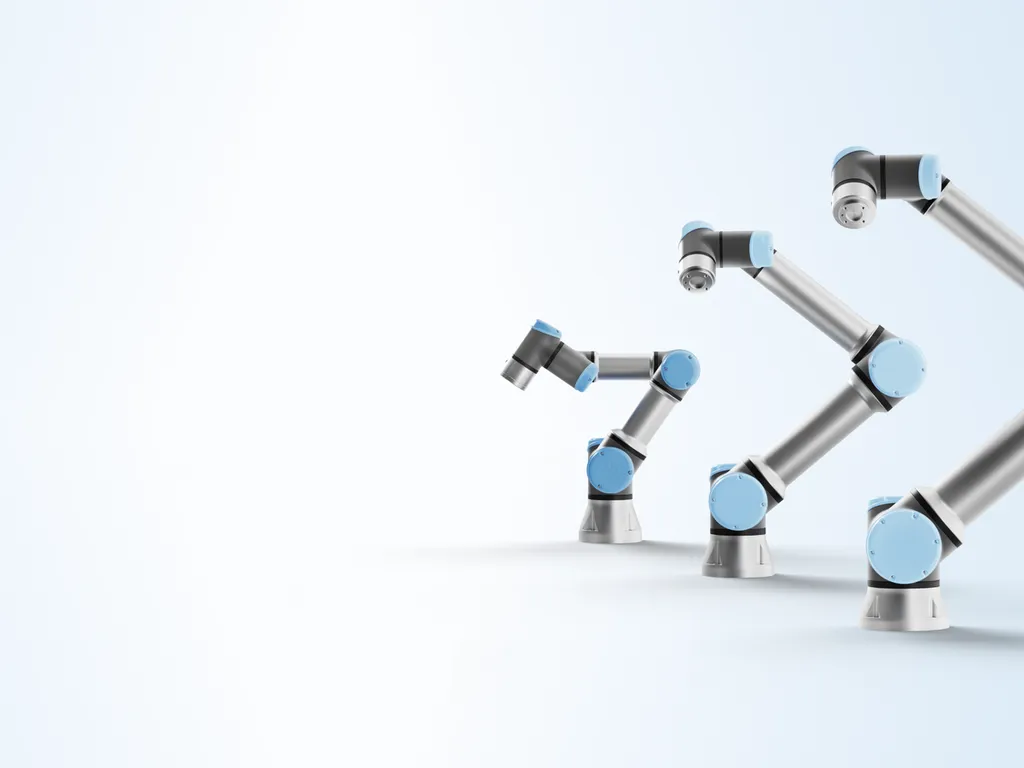
Before you spec a gripper, check the flange. Of the 339 robots in our database, 50 publish an ISO 9409-1 tool flange designation, and 23 of those 50 carry the same one: ISO 9409-1-50-4-M6. A 50 mm bolt circle with four M6 threads is the closest thing the industry has to a default, and it is the reason a shelf full of cobot grippers appears to fit everything.
It does not fit everything. Nine of the 29 cobots in this dataset are on some other pattern, and two of them are Universal Robots models sitting right next to the ones that made 50-4-M6 the default in the first place.
What the designation actually encodes
ISO 9409-1:2004, Manipulating industrial robots, Mechanical interfaces, Part 1: Plates, is a short standard with one job. Its scope is to define “the main dimensions, designation and marking for a circular plate as mechanical interface”, so that end effectors stay exchangeable and keep their orientation.
Clause 5 gives the designation code, and it is readable once you know the order:
| Segment | Meaning | Example |
|---|---|---|
| First number | Pitch circle diameter of the bolt pattern, in mm | 50 |
| Second number | Number of threaded holes on that circle | 4 |
| Third segment | Thread size per ISO 261 | M6 |
The standard’s own worked example is a 160 mm pitch circle with six M10 holes, written ISO 9409-1-160-6-M10. So ISO 9409-1-50-4-M6 is a 50 mm circle, four holes, M6 thread. There is also a location pin hole, which the standard requires to be aligned with the +Xm axis of the mechanical interface coordinate system, and that is what keeps a tool’s orientation repeatable rather than just its position.
Two things the standard deliberately does not do. It does not define the rest of the coupling device, so quick-change systems, pneumatics and electrical pass-through are all outside it. And it states plainly that it “does not contain any correlation of load-carrying ranges”, leaving the interface choice to the application and the robot’s capacity. Hold onto that, because the data disagrees with it in an interesting way.
The lookup: 50 robots, 13 designations
Sorted by pitch circle diameter, smallest first.
| Robot | Brand | Type | Payload | Reach | Flange designation |
|---|---|---|---|---|---|
| HC10DTP | Yaskawa | Cobot | 10 kg | 1,200 mm | ISO 9409-1 |
| HC20DTP | Yaskawa | Cobot | 20 kg | 1,700 mm | ISO 9409-1 |
| HC30PL | Yaskawa | Cobot | 30 kg | 1,700 mm | EN ISO 9409-1 |
| KR 3 AGILUS | KUKA | Articulated | 3 kg | 541 mm | ISO 9409-1-20-4-M3 |
| KR DELTA | KUKA | Delta | 3 kg | 1,200 mm | ISO 9409-1-20-4-M3 |
| KR SCARA R600 | KUKA | SCARA | 8 kg | 600 mm | ISO 9409-1-20-4-M3 |
| IRB 1010 | ABB | Articulated | 1.5 kg | 370 mm | ISO 9409-1-31.5-4-M5 |
| IRB 1100 | ABB | Articulated | 4 kg | 580 mm | ISO 9409-1-31.5-4-M5 |
| SWIFTI CRB 1100-4/0.58 | ABB | Cobot | 4 kg | 580 mm | ISO 9409-1-31.5-4-M5 |
| KR 6 R700 sixx | KUKA | Articulated | 6 kg | 706 mm | ISO 9409-1-31.5-4-M5 |
| KR 10 R900 sixx | KUKA | Articulated | 10 kg | 901 mm | ISO 9409-1-31.5-4-M5 |
| LBR iisy 3 R760 | KUKA | Cobot | 3 kg | 760 mm | ISO 9409-1-31.5-4-M5 |
| IRB 1660ID-6/1.55 | ABB | Articulated | 6 kg | 1,550 mm | ISO 9409-1-40-4-M6 |
| IRB 1200-7/0.7 | ABB | Articulated | 7 kg | 700 mm | ISO 9409-1-40-4-M6 |
| IRB 1600-10/1.45 | ABB | Articulated | 10 kg | 1,450 mm | ISO 9409-1-40-4-M6 |
| IRB 1300-11/0.9 | ABB | Articulated | 11 kg | 900 mm | ISO 9409-1-40-4-M6 |
| LR Mate 200iD/7L | FANUC | Articulated | 7 kg | 911 mm | ISO 9409-1-40-4-M6 |
| KR 10 R1100-2 (AGILUS) | KUKA | Articulated | 10 kg | 1,101 mm | ISO 9409-1-40 |
| UR3e | Universal Robots | Cobot | 3 kg | 500 mm | ISO 9409-1-50-4-M6 |
| GoFa CRB 15000 (5 kg) | ABB | Cobot | 5 kg | 950 mm | ISO 9409-1-50-4-M6 |
| UR5e | Universal Robots | Cobot | 5 kg | 850 mm | ISO 9409-1-50-4-M6 |
| UR7e | Universal Robots | Cobot | 7.5 kg | 850 mm | ISO 9409-1-50-4-M6 |
| GoFa CRB 15000-10/1.52 | ABB | Cobot | 10 kg | 1,520 mm | ISO 9409-1-50-4-M6 |
| CRX-10iA | FANUC | Cobot | 10 kg | 1,249 mm | ISO 9409-1-50-4-M6 |
| CRX-10iA/L | FANUC | Cobot | 10 kg | 1,418 mm | ISO 9409-1-50-4-M6 |
| Motoman HC10 | Yaskawa | Cobot | 10 kg | 1,200 mm | ISO 9409-1-50-4-M6 |
| LBR iisy 11 R1300 | KUKA | Cobot | 11 kg | 1,300 mm | ISO 9409-1-50-4-M6 |
| GoFa CRB 15000-12/1.27 | ABB | Cobot | 12 kg | 1,270 mm | ISO 9409-1-50-4-M6 |
| TM12 | Techman | Cobot | 12 kg | 1,300 mm | ISO 9409-1-50-4-M6 |
| UR10e | Universal Robots | Cobot | 12.5 kg | 1,300 mm | ISO 9409-1-50-4-M6 |
| UR12e | Universal Robots | Cobot | 12.5 kg | 1,300 mm | ISO 9409-1-50-4-M6 |
| LBR iiwa 14 R820 | KUKA | Cobot | 14 kg | 820 mm | ISO 9409-1-50-4-M6 |
| LBR iisy 15 R930 | KUKA | Cobot | 15 kg | 930 mm | ISO 9409-1-50-4-M6 |
| UR16e | Universal Robots | Cobot | 16 kg | 900 mm | ISO 9409-1-50-4-M6 |
| UR15 | Universal Robots | Cobot | 17.5 kg | 1,300 mm | ISO 9409-1-50-4-M6 |
| KR 20 R1810 | KUKA | Articulated | 20 kg | 1,813 mm | ISO 9409-1-50-4-M6 |
| KR 20 R3100 IONTEC | KUKA | Articulated | 20 kg | 3,101 mm | ISO 9409-1-50-4-M6 |
| CRX-20iA/L | FANUC | Cobot | 20 kg | 1,418 mm | ISO 9409-1-50-4-M6 |
| H2515 | Doosan | Cobot | 25 kg | 1,500 mm | ISO 9409-1-50-4-M6 |
| CRX-25iA | FANUC | Cobot | 30 kg | 1,889 mm | ISO 9409-1-50-4-M6 |
| KR 30 R2100 | KUKA | Articulated | 30 kg | 2,101 mm | ISO 9409-1-50-4-M6 |
| LBR iiwa 7 R800 | KUKA | Cobot | 7 kg | 800 mm | ISO 9409-1-63 |
| UR20 | Universal Robots | Cobot | 20 kg | 1,750 mm | ISO 9409-1-80-6-M8 |
| UR30 | Universal Robots | Cobot | 35 kg | 1,300 mm | ISO 9409-1-80-6-M8 |
| CR-35iB | FANUC | Cobot | 50 kg | 1,813 mm | ISO 9409-1-100 |
| KR 70 R2100 | KUKA | Articulated | 70 kg | 2,101 mm | ISO 9409-1-100-4-M8 |
| KR 120 R2700-2 | KUKA | Articulated | 120 kg | 2,701 mm | ISO 9409-1-100-4-M8 |
| KR 210 R2700-2 (QUANTEC) | KUKA | Articulated | 210 kg | 2,700 mm | ISO 9409-1-100-4-M8 |
| KR 500 R2830 | KUKA | Articulated | 500 kg | 2,826 mm | ISO 9409-1-160-4-M12 |
| KR 1000 TITAN | KUKA | Articulated | 1,000 kg | 3,202 mm | ISO 9409-1-250-4-M16 |
Three Yaskawa cobots publish the family name without the size suffix, so they appear at the top rather than in the ladder. Two KUKA entries give a pitch circle but not the hole count and thread. Those are the manufacturers’ own published strings, and we have not guessed at the missing segments.
The flange ladder tracks payload, and the standard says it should not
Group the fully qualified designations by pitch circle and the payload bands line up almost cleanly:
| Designation | Robots | Payload range |
|---|---|---|
ISO 9409-1-20-4-M3 | 3 | 3 to 8 kg |
ISO 9409-1-31.5-4-M5 | 6 | 1.5 to 10 kg |
ISO 9409-1-40-4-M6 | 5 | 6 to 11 kg |
ISO 9409-1-50-4-M6 | 23 | 3 to 30 kg |
ISO 9409-1-80-6-M8 | 2 | 20 to 35 kg |
ISO 9409-1-100-4-M8 | 3 | 70 to 210 kg |
ISO 9409-1-160-4-M12 | 1 | 500 kg |
ISO 9409-1-250-4-M16 | 1 | 1,000 kg |
A 3 kg arm gets three M3 screws on a 20 mm circle. A 1,000 kg arm gets four M16 screws on a 250 mm circle. That is not the standard telling anyone what to do. ISO 9409-1 refuses to correlate flange size with load, on the grounds that the right interface depends on the application. What you are looking at is 30 years of manufacturers independently arriving at the same sensible answer.
The interesting row is the 50 mm one, because it does not behave. It spans a ten-fold payload range, from the 3 kg UR3e to the 30 kg FANUC CRX-25iA and the 30 kg KUKA KR 30 R2100. That single overloaded row is the whole reason the cobot gripper aftermarket works. If you build a gripper for 50-4-M6, you address nearly half the flange-published catalog in one product.
The four traps in this table
Universal Robots is not one flange. UR3e, UR5e, UR7e, UR10e, UR12e, UR15 and UR16e are all 50-4-M6. UR20 and UR30 are ISO 9409-1-80-6-M8, a bigger circle with six bolts instead of four. If you are stepping up from a UR10e cell to a UR20, your existing tooling does not bolt straight on. This is the single most expensive assumption in the dataset, because UR is exactly the brand people assume is internally consistent.
KUKA’s LBR iiwa splits within the family. The LBR iiwa 7 R800 is on a 63 mm pattern. The LBR iiwa 14 R820, the same product line, is on 50-4-M6. Two arms, one family name, two flanges.
FANUC’s cobot line splits at the top. The whole CRX range, from the CRX-10iA up to the 30 kg CRX-25iA, is 50-4-M6. The 50 kg CR-35iB jumps to a 100 mm pattern.
Cobot does not imply 50-4-M6. Nine of 29 cobots here are on something else, including two ABB and KUKA small arms on the 31.5 mm M5 pattern shared with their own industrial siblings. The ABB SWIFTI CRB 1100 uses the same flange as the industrial IRB 1100 it is derived from, which is logical engineering and a nasty surprise if you ordered on the assumption that a collaborative badge meant a collaborative flange.
What to do when they do not match
Adapter plates. This is a solved problem, and the fact that it is solved commercially is itself evidence of how common mismatches are. OnRobot’s flange adapter kit exists specifically to “convert flanges from different robots to the standard ISO 9409-1-50-4-M6 flange”, with distinct adapter types for KUKA, FANUC, ABB, Yaskawa, Kawasaki and Nachi arms.
The plate is cheap. The consequence is not always. An adapter sits between the wrist face and the tool, so it adds stack height, pushes the tool centre point further from the wrist, and increases the moment the wrist has to carry for the same gripper mass. On an arm already close to its rated limit that matters, and it is the same leverage problem that makes wrist torque a better sizing check than payload alone. Check the adapter’s thickness against your payload margin before you treat it as a free fix, and factor the new tool offset into your reach and clearance calculation rather than assuming the arm’s published reach still applies to your gripper tip.
Coverage, and one correction we made
Only 50 of 339 robots, 14.7% of the catalog, publish a tool flange designation in a form we can record. That is a genuine gap and not a claim that the other 289 lack a standard flange. Most of them almost certainly have one. It simply is not in the datasheet text we have collected, and we do not invent spec values to fill a column. Seven brands are represented here: KUKA with 19 entries, ABB with 10, Universal Robots with nine, FANUC with six, Yaskawa with four, and one each from Doosan and Techman. Every other brand in the database publishes nothing we could use.
While building this table we also found and removed a data error of our own. Eleven FANUC records carried “ISO 9283” in the tool flange field. ISO 9283 is the performance criteria and test methods standard, the one that defines how repeatability is measured, and FANUC datasheets cite it next to the repeatability figure. It is not a flange pattern. Those eleven robots now show no flange value rather than a wrong one, which is the honest state until we source the real designations. The 50 robots above are what is left after that correction.
If you are working out what physically fits where in a cell, the flange is only the last 50 mm of the problem. The mounting orientation of the robot itself sets everything upstream of it.
Sources: ISO 9409-1:2004 published text, clauses 1 and 5 (ISO preview PDF) and its ISO catalogue entry; OnRobot flange adapter kit product description. Robot flange designations from the Industrial Robotics Hub database, current as of 25 July 2026.
Frequently asked questions
What does ISO 9409-1-50-4-M6 mean? +
It is the designation code defined in clause 5 of ISO 9409-1:2004. The first number is the pitch circle diameter of the bolt pattern in millimetres, 50 mm. The second is the number of threaded holes on that circle, 4. The last is the thread size, M6. The standard's own worked example is ISO 9409-1-160-6-M10, meaning a 160 mm pitch circle with six M10 holes.
Do all collaborative robots use the same tool flange? +
No. Of the 29 cobots in our database that publish a flange designation, 20 use ISO 9409-1-50-4-M6 and nine do not. The exceptions include both large Universal Robots models (UR20 and UR30 use an 80 mm pattern with six M8 holes), the KUKA LBR iiwa 7 R800 (63 mm), the ABB SWIFTI CRB 1100 and KUKA LBR iisy 3 (31.5 mm with M5), and the FANUC CR-35iB (100 mm). Assuming every cobot shares one flange is the most common way people end up ordering the wrong gripper.
Does a bigger robot always mean a bigger flange? +
In practice the two track each other closely, from 20 mm patterns on 3 kg arms up to a 250 mm pattern with M16 bolts on the 1,000 kg KUKA KR 1000 TITAN. But ISO 9409-1 says explicitly that it 'does not contain any correlation of load-carrying ranges', and leaves the interface choice to the application and the robot's capacity. The ladder is a market convention, not a rule of the standard, and there is real overlap: the 50 mm pattern alone spans 3 kg to 30 kg robots.
What if my gripper does not match my robot's flange? +
You use an adapter plate, and gripper vendors sell them precisely because mismatches are normal. OnRobot's flange adapter kit, for example, exists to convert flanges from other robots to the ISO 9409-1-50-4-M6 pattern, with separate adapter types for KUKA, FANUC, ABB, Yaskawa, Kawasaki and Nachi arms. The cost is not the plate. It is the extra thickness between the wrist and the tool, which pushes the tool centre point further out and increases the leverage the wrist has to hold, eating into your payload margin.
Compare these robots