Robotics Earnings Split: Cobots Surge, Yaskawa Stumbles, ABB Exits
Teradyne Robotics grew 33%, Yaskawa's robot profit fell 82%, and ABB's robotics exit firmed up — three earnings that show hardware money chasing data centers, not arms.
Three earnings reports from the same week — Teradyne, ABB, Yaskawa — tell three different stories about where robotics money is going in 2026, and none of them is simply “robots are booming.” Teradyne Robotics grew revenue 33% year-over-year; ABB booked record $12.04 billion orders while formally treating its own robotics business as discontinued; Yaskawa’s Robotics segment profit collapsed 82.3% even as the rest of the company grew. The thread running through this week’s coverage — those three earnings reports plus a new chip entrant, a certification first, and a cluster of training-facility and integration stories — is that capital is flowing to whatever sits closest to AI-driven electronics and data-center demand, and robotics hardware is having to prove it belongs in that story rather than assume it.
Thread 1: earnings season splits robotics from the AI buildout
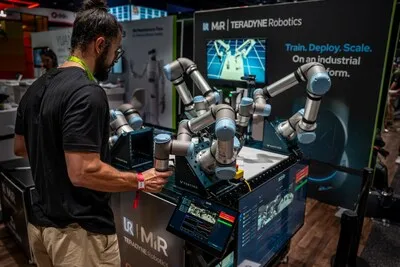
Teradyne Robotics — Universal Robots’ cobots and MiR’s AMRs — posted $100 million in Q2 2026 revenue, up 33% from $75 million a year earlier and up from $91 million in Q1, a fifth consecutive growth quarter. That’s real growth, but it’s also just 7.5% of Teradyne’s $1,329 million total revenue, a company now dominated by AI-chip semiconductor test demand.
ABB posted its highest-ever quarterly order figure — $12.04 billion, up 28% comparable — with its Electrification business area citing “exceptional” data-center order growth as the driver. Meanwhile ABB’s 2026 guidance already presents Robotics on a discontinued-operations basis ahead of a divestment expected to close in the second half of 2026, funding roughly $4.8 billion of its $5.5 billion Rotork acquisition (a flow-control equipment maker, not robotics) with the proceeds. ABB’s Q2 materials don’t restate a buyer for Robotics, but one has been public for nine months: ABB announced in October 2025 it agreed to sell the division to SoftBank Group for roughly $5.375 billion, a deal that predates and is separate from Rotork. ABB is funding an electrification bet with the proceeds of its robotics exit, not reinvesting in robots.
Yaskawa’s Q1 FY2026 results are the sharpest illustration of the split inside one company. Revenue rose 10.6% to ¥138.98 billion, but operating profit fell 19.2% because Robotics segment operating profit collapsed 82.3%, to ¥888 million from roughly ¥5.0 billion, on flat segment revenue (+2.0%). Yaskawa attributes the drop to an ERP migration and unspecified European restructuring costs, not weaker orders. Motion Control, its servo-and-drives business, moved the opposite direction: operating profit up 50.1% on “expanding demand, particularly in semiconductor- and data center-related applications.” Calculated from Yaskawa’s disclosed figures, that gap looks like this:
Yaskawa left its full-year guidance unchanged, language it frames as still assessing recovery rather than confirming the ERP problem is behind it. Read together, the three reports say robotics hardware remains profitable but isn’t where AI-buildout capital is concentrating: the growth vector this quarter is data-center-adjacent electrification and motion control, Yaskawa’s pain looks temporary and self-inflicted, and ABB’s exit is a permanent strategic choice.
Thread 2: a second chip vendor shows up behind Nvidia, without OEM names yet
The same week, AMD launched its Ryzen AI Embedded X100 processor family — up to 16 Zen 5 cores, a 40-compute-unit GPU, 50 TOPS of NPU throughput in a 55-watt envelope — bundled into a Kria AI Robotics Developer Platform alongside a free, tiered Robotics Partner Network. Sampling started in June; general availability targets Q4. The only named partner at launch was the Digital Twin Consortium, a standards body, not a robot maker, and a fresh check on August 1 found no primary-source confirmation that FANUC, KUKA, Yaskawa, ABB, or Universal Robots has committed to the platform since. That contrasts with the coalition this desk covered in mid-July, where FANUC, Yaskawa, Kawasaki, and Fujitsu committed to Nvidia’s Cosmos stack backed by a ¥387.3 billion Japanese government tranche — real industrial-OEM names already attached. AMD is trying to become table-stakes infrastructure through an open, no-fee network; Nvidia already has OEM lock-in through a government-backed one.
Thread 3: compliance becomes a two-axis stack
KUKA’s iiQKA.OS2 became the first robot operating system certified to IEC 62443-4-2 Security Level 2 cybersecurity, covering every KUKA kinematic type on its KR C5 controller family. That sits alongside, not instead of, EN ISO 10218-1:2025 physical-safety compliance, and is positioned against the EU Cyber Resilience Act’s push toward mandatory cybersecurity certification for connected industrial equipment. It’s a genuine first-to-market claim today; the more interesting question is how long it stays one, since regulatory pressure — not just competitive pressure — is pushing every robot maker toward the same second axis.
Thread 4: training-facility capex is real, validation claims often aren’t
Two stories show this pattern from opposite directions. NEURA Robotics opened a 3,000-square-meter “Physical AI” training facility with RWTH Aachen, embedding roughly 20 university institutes — a concrete, verifiable partnership. But NEURA’s claims of ten such “Gyms” globally, five operational by year-end, and an “up to $1.4 billion” Series C are entirely company-reported, with no independent confirmation found. Separately, Elite Robots said its cobots ran 1,800-plus zero-intervention block-stacking trials validating Generalist AI’s GEN-1 model — except the marquee 99%-success, 3x-speed, and 64%-baseline figures turn out to be recycled from Generalist’s own April 2026 blog post, not new July results, and Generalist has never publicly named Elite as a hardware partner. Infrastructure spending is verifiable; the outputs attached to it frequently aren’t.
Two smaller stories bookended the drama with more concrete ground. Eclipse Automation, a Cambridge, Ontario systems integrator rather than a robot maker, landed $6 million CAD in federal funding — part of a roughly $40.5 million regional package — for a digital-manufacturing hub built on its Gaussian-splatting-and-Apple-Vision-Pro simulation product. And Techman Robot’s AI-vision cobots now run automated optical inspection on ADAS and EV electronics lines at parent Quanta Computer’s German plant, checking boards with nearly 5,000 components each — a real deployment, though neither company disclosed which TM cobot model is installed, a genuine reporting gap rather than an omission worth glossing over.
What connects the threads
Every thread points the same direction: money and infrastructure bets in robotics are chasing proximity to AI compute and data-center demand, not robots themselves. Yaskawa’s Motion Control and ABB’s Electrification businesses grew on data-center-adjacent orders while their own robot units struggled or were sold off. AMD is trying to buy into the physical-AI compute race the way Nvidia already has, through OEM relationships. And the training-facility stories show companies racing to claim they’ve solved physical AI’s “real-world data” problem, with proof lagging well behind the press releases in every case examined this week.
Sources
- Teradyne Reports Second Quarter 2026 Results — Teradyne, Inc., Jul 28, 2026
- Q2 2026 results — Record-high orders, strong operational execution and value creation through M&A — ABB, Jul 16, 2026
- Consolidated Results for the First Quarter of Fiscal Year Ending February 28, 2027 [IFRS] — YASKAWA Electric Corporation, Jul 10, 2026
- ABB to divest Robotics division to SoftBank Group — ABB, Oct 8, 2025
- AAI 2026: New AMD Open Robotics Partner Network for Physical AI Development — AMD Newsroom, Jul 23, 2026
- KUKA iiQKA.OS reaches Product Security Level 2 — KUKA, Jul 21, 2026
- New NEURA Gym with RWTH Aachen: NEURA Robotics Expands its Global Training Network for Physical AI — NEURA Robotics (official), Jul 22, 2026
- Elite Robots Collaborates with Generalist AI on Next-Gen Embodied AI — PR Newswire (Elite Robots), Jul 21, 2026
- Government of Canada invests nearly $40.5 million in Waterloo and Brant Region businesses and organizations — Government of Canada / FedDev Ontario, Jul 24, 2026
- Quanta Computer Partners with Techman Robot at German Facility to Set New Benchmark for Smart Automotive Manufacturing — Techman Robot, Jul 1, 2026
Frequently asked questions
Why did Yaskawa's robotics profit fall 82% if revenue was flat? +
Yaskawa attributes the drop to production disruption from a new ERP system plus unspecified costs from a European business-structural reform, not weaker demand — Robotics segment revenue was still up 2.0% year-over-year. The company left its full-year guidance unchanged, which it frames as still assessing recovery rather than confirming the problem is resolved.
Is ABB abandoning industrial robots, and who is buying the business? +
ABB is divesting its Robotics division to SoftBank Group for an enterprise value of roughly $5.375 billion, a deal ABB announced back in October 2025 and still expects to close in the second half of 2026. ABB's own Q2 2026 earnings materials don't restate SoftBank's name, but the buyer has been public for nine months; separately, ABB is redirecting the divestment's ~$4.8 billion in expected net proceeds toward its $5.5 billion Rotork acquisition, which doesn't close until the first half of 2027.
Has any major robot maker adopted AMD's new Ryzen AI X100 chip? +
Not as of this writing. As of AMD's own July 23 launch materials and a fresh check on August 1, the only named Robotics Partner Network member is the Digital Twin Consortium, a standards body, not a robot maker — no confirmation was found that FANUC, KUKA, Yaskawa, ABB, or Universal Robots has committed to the X100 or Kria platform.
Is KUKA's cybersecurity certification a lasting edge or a temporary one? +
It's a genuine first — KUKA is the only robot maker with a component certified to IEC 62443-4-2 Security Level 2 as of this writing — but the EU Cyber Resilience Act is pushing connected industrial equipment toward mandatory cybersecurity certification generally, which makes this look more like a head start than a permanent moat.
More news